SRT Streamer PRO V1.3 (build 160) – (Professional Multi-Input SRT Encoder & Smart Broadcaster) Latest 2026
Summary
SRT Streamer PRO V1.3 (build 160) is an advanced professional multi-input software encoder and broadcaster by GaraninApps designed for 24/7/365 live video contribution, multi-camera capture, and ultra-low-latency transmission.
SRT Streamer PRO is a professional-grade, multi-input software encoder designed to capture, encode, and transmit high-quality live video streams using the SRT protocol. Unlike consumer-grade software like OBS (which is great for gaming but lacks broadcast reliability), this tool is built for mission-critical contribution feeds.
This June 2026 update from TeamArman transforms any standard Windows computer into a broadcast-grade encoding station. Whether you are a news crew transmitting from a remote village, a sports producer handling 4K multi-camera feeds, or an enterprise broadcaster requiring 24/7/365 uptime, this software delivers.
Technical Deep-Dive: The SRT Protocol Explained
To truly appreciate this software, you must understand the protocol that powers it.
What Makes SRT Different?
Traditional protocols (RTMP, UDP, RTP) fail miserably on public internet because they cannot recover lost packets. SRT includes three game-changing technologies:
-
Packet Recovery (ARQ – Automatic Repeat Request): If a packet is lost, the receiver asks the sender to resend it. This happens in milliseconds.
-
End-to-End AES Encryption: Your stream is secured with 128, 192, or 256-bit AES encryption. No one can intercept your feed.
-
Adaptive Bitrate (Not in all implementations, but SRT allows it): The protocol can adjust to bandwidth changes.
SRT Modes in SRT Streamer PRO
This software supports both Caller and Listener modes, plus a Rendezvous mode for firewall traversal.
| Mode | Description | Use Case |
|---|---|---|
| Caller | Software initiates the connection to a remote server | Sending feed from field to studio |
| Listener | Software waits for incoming connections | Studio receiving multiple remote feeds |
| Rendezvous | Both sides connect simultaneously | Firewall/NAT traversal (difficult networks) |
Mastering Multi-Input Encoding
One of the biggest headaches in professional broadcasting is managing multiple disparate sources. A single production might involve:
-
Two SDI cameras
-
One HDMI laptop feed
-
One NDI screen capture
-
One remote RTSP security camera
SRT Streamer PRO handles all of these simultaneously.
Supported Input Formats
-
SDI (Serial Digital Interface): Professional broadcast cameras via capture cards (Blackmagic DeckLink, Aja, Magewell)
-
HDMI: Consumer and prosumer cameras, gaming consoles, computers
-
NDI (Network Device Interface): IP-based video sources from NewTek and other NDI-enabled software
-
RTSP (Real Time Streaming Protocol): IP cameras, security feeds, remote sensors
-
UDP Multicast: Internal network video distribution
Codec Support for Encoding
The software supports three primary codecs, each with specific advantages:
| Codec | Bitrate Efficiency | Hardware Acceleration | Best For |
|---|---|---|---|
| H.264 (AVC) | Standard | Yes (Intel QSV, NVIDIA NVENC, AMD VCE) | Universal compatibility, streaming to CDNs |
| HEVC (H.265) | 40-50% better than H.264 | Yes (Newer GPUs) | 4K streaming, lower bandwidth contribution |
| MPEG-2 | Poor (Legacy) | Limited | Legacy broadcast systems, older hardware |
Step-by-Step Setup Guide for Beginners
Let us walk through a basic setup to get you streaming within 15 minutes.
Prerequisites
-
Windows 10/11 PC with at least 8GB RAM (16GB recommended)
-
One capture card or NDI source
-
Stable internet connection (5 Mbps upload minimum)
-
SRT Streamer PRO V1.3 Build 160 installed
Step 1 – Input Configuration
-
Launch the Web GUI by typing
http://localhost:8080in your browser. -
Navigate to Input Sources > Add Source.
-
Select your input type: SDI, HDMI, NDI, or RTSP.
-
Choose your capture device from the dropdown menu.
-
Set your resolution and frame rate (e.g., 1920×1080 at 59.94 fps).
Step 2 – Encoding Settings
-
Go to Encoding > Video Settings.
-
Select your codec: H.264 or HEVC (H.265).
-
Set your bitrate:
-
1080p: 4-8 Mbps (HEVC) or 8-12 Mbps (H.264)
-
720p: 2-4 Mbps (HEVC) or 4-6 Mbps (H.264)
-
-
Enable GPU Acceleration if available (NVIDIA NVENC or Intel QSV).
Step 3 – SRT Output Configuration
-
Navigate to Output > SRT Stream.
-
Select Caller Mode (you are sending to a remote server).
-
Enter the Destination IP and Port (provided by your studio).
-
Set Passphrase for AES encryption (minimum 10 characters, up to 79).
-
Configure Latency (default 125ms is safe; increase to 500ms for unstable networks).
Step 4 – Start Streaming
-
Click Apply to save all settings.
-
Click Start Stream.
-
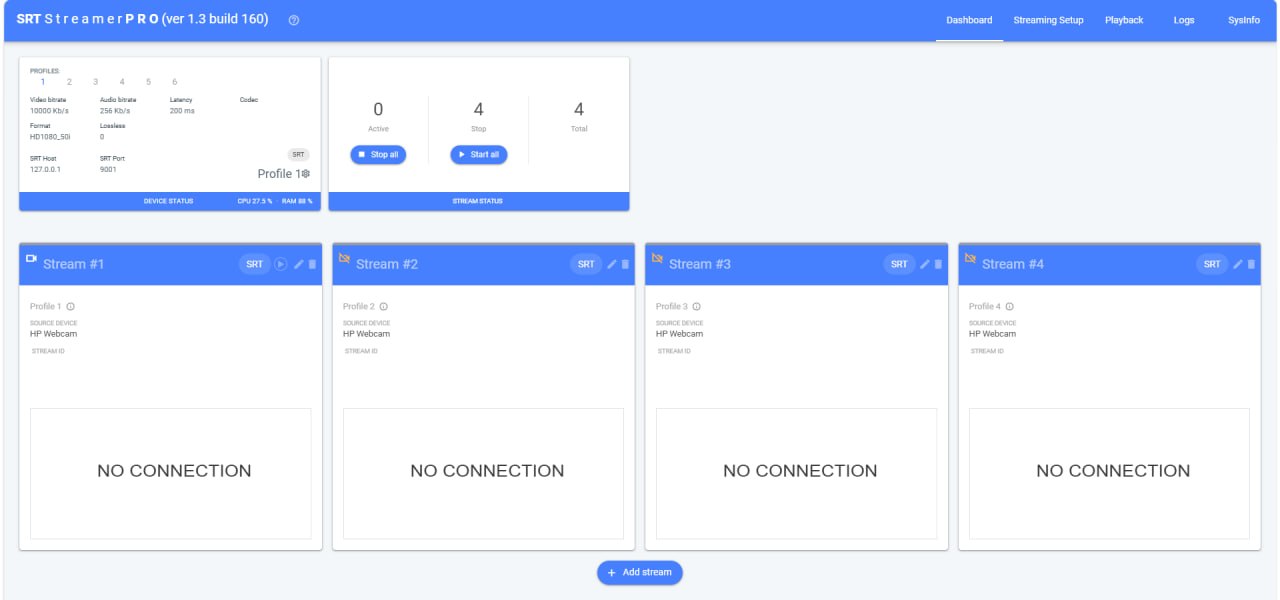
Monitor the Stats Panel for bitrate, packet loss, and uptime.
Troubleshooting Tip: If you see packet loss above 1%, increase your latency setting. If you see frame drops, lower your bitrate or switch from H.264 to HEVC.
Advanced Features Deep-Dive (Build 160 Highlights)
Version 1.3 Build 160 introduces several professional-grade features that set this software apart.
Two-Way Communication (Return Feeds)
Most encoders are one-way: field to studio. It supports bidirectional communication.
How it works:
-
Your stream goes upstream to the studio (Program Feed).
-
The studio sends a return feed back to you (Confidence Monitor / Return Video).
-
This return feed can be output to an SDI or NDI device.
Real-world use case: A remote camera operator sees exactly what the director sees. When the director says “zoom in on the quarterback,” the operator sees the framing in real-time on their confidence monitor.
Loss-Less Mode
This is not marketing jargon. Loss-Less Mode prioritizes data integrity over speed.
| Mode | Behavior | Best For |
|---|---|---|
| Standard Mode | Drops packets after failed retries | General streaming (sports, news, events) |
| Loss-Less Mode | Continuously retries until packet is delivered | Archival feeds, legal evidence, medical video, any content where every pixel matters |
Caution: Loss-Less Mode increases latency (up to 2-3 seconds). Only use when video integrity is more important than real-time delivery.
Auto-Reconnect (24/7/365 Operation)
Network interruptions are inevitable. A fiber cut, a 4G signal drop, a router reboot – any of these can kill a stream.
SRT Streamer PRO handles this automatically.
-
When a disconnection is detected, the software attempts to reconnect every 2 seconds.
-
Once reconnected, the stream resumes without manual intervention.
-
The destination server must support SRT reconnection (most modern SRT receivers do).
Multicast Output
If you need to distribute a single encoded stream to multiple local devices (monitoring stations, recorders, secondary encoders), multicast is your answer.
-
One encoded stream enters the software.
-
The software outputs the same stream to multiple local IP addresses.
-
Zero additional CPU usage because encoding happens once.
Comparative Analysis – SRT Streamer PRO vs. The Competition
Let us be objective. How does this software stack against alternatives?
vs. OBS Studio (Free)
| Feature | OBS Studio | SRT Streamer PRO |
|---|---|---|
| Price | Free | Paid (Professional) |
| SRT Support | Basic (via plugin, unstable) | Native, full implementation |
| Two-Way Communication | No | Yes |
| Lossless Mode | No | Yes |
| 24/7 Auto-Reconnect | No (requires scripting) | Yes (built-in) |
| Web-Based Remote Control | No (requires third-party plugins) | Yes (native) |
| Multicast Output | No | Yes |
Verdict: OBS is excellent for gaming and basic streaming. For professional broadcast contribution, SRT Streamer PRO is objectively superior.
vs. Hardware Encoders (Teradek, Haivision)
| Feature | Hardware Encoder ($3k-$15k) | SRT Streamer PRO |
|---|---|---|
| Upfront Cost | Very High | Low (Software License) |
| Portability | One device = one stream | Unlimited instances on one PC |
| Codec Updates | Requires firmware updates (slow) | Instant (software update) |
| Repair | Send to manufacturer | Reinstall on new PC |
| Remote Management | Often limited | Full web GUI from anywhere |
| Redundancy | Buy two units | Run two instances on one PC |
Verdict: Hardware encoders make sense for large broadcast trucks with dedicated budgets. For everyone else – remote producers, news crews, enterprise IT – the software solution wins.
Real-World Use Cases
Let us move beyond features into actual workflows.
Use Case 1 – Live Sports (Multi-Camera Remote Production)
Scenario: A high school football game needs to be broadcast with three cameras. No fiber connection available. Only two bonded 4G modems.
Solution with SRT Streamer PRO:
-
Camera 1 (SDI) → Capture Card → PC
-
Camera 2 (HDMI) → Capture Card → PC
-
Camera 3 (NDI over WiFi) → Network → PC
-
All three inputs are synchronized, encoded with HEVC at 6 Mbps each (total 18 Mbps).
-
SRT protocol handles packet loss across the two bonded 4G connections.
-
Studio receives three clean feeds and switches live.
Result: Professional broadcast quality over consumer internet.
Use Case 2 – Remote News Contribution
Scenario: A journalist is reporting from a protest zone. Internet is unstable, with 30% packet loss.
Solution:
-
Single SDI camera into laptop running SRT Streamer PRO.
-
Lossless Mode enabled (video integrity is critical for news).
-
Latency increased to 2000ms to allow for retransmissions.
-
Studio receives every single frame, even if delayed by 2 seconds.
Result: News director gets clean video. No artifacts, no freezing. Every pixel arrives.
Use Case 3 – 24/7 Enterprise Monitoring
Scenario: A casino needs to monitor 50 slot machine areas 24/7. One central security office. No budget for 50 hardware encoders.
Solution:
-
One powerful Windows Server with four capture cards (each card handles 8-12 inputs via SDI multiplexing).
-
SRT Streamer PRO encodes all 50 feeds simultaneously.
-
Multicast output distributes each feed to multiple monitoring stations.
-
Auto-reconnect ensures no feed goes dark during network maintenance.
Result: $500,000 saved compared to hardware encoders.
Troubleshooting Common Issues
Even professional software encounters issues. Here is how to solve them.
Issue 1 – High Packet Loss (Above 2%)
Symptoms: Video stuttering, macro-blocking, audio dropouts.
Solutions:
-
Increase latency setting (try 250ms, then 500ms, then 1000ms).
-
Lower your bitrate by 20-30%.
-
Switch from H.264 to HEVC (same quality at lower bitrate).
-
Check your upload speed (Speedtest.net). If unstable, contact your ISP.
H3: Issue 2 – Stream Will Not Connect
Symptoms: “Connection Failed” error in logs.
Solutions:
-
Verify Caller/Listener modes match (one side must be Caller, other Listener).
-
Check firewall settings (Ports 2088, 2089, 2090 commonly used for SRT).
-
Confirm the destination IP address is correct.
-
Verify the passphrase matches exactly (case-sensitive).
H3: Issue 3 – GPU Encoding Not Working
Symptoms: High CPU usage (90%+) when encoding.
Solutions:
-
Update your graphics drivers (NVIDIA Studio Drivers recommended).
-
Verify your GPU supports NVENC (GTX 1050 or newer) or Intel QSV (6th gen Intel or newer).
-
In encoding settings, manually select your GPU instead of “Auto.”
-
Ensure no other software is using GPU encoding (OBS, Discord, Chrome).
H3: Issue 4 – Audio/Video Sync Drift
Symptoms: Lip sync issues that get worse over time.
Solutions:
-
Enable Timecode Insertion in advanced settings.
-
Use a dedicated audio capture card instead of embedded HDMI audio.
-
Set both audio and video sample rates to match (48 kHz is broadcast standard).
-
Restart the stream every 24 hours (some hardware drivers have memory leaks).
Security and Legal Compliance
SRT Streamer PRO implements AES-128, AES-192, and AES-256 encryption. For most use cases, AES-128 is sufficient. For government or medical video, use AES-256.
-
In SRT output settings, enter a Passphrase (minimum 10 characters).
-
Select your encryption strength.
-
Share the passphrase with your receiving server out-of-band (not over email if possible).
-
Software cracks or keygens
-
License bypass or activation hacks
-
Pirated versions of any software
-
Torrent links or unauthorized distribution
FAQs
Q1: Can SRT Streamer PRO replace my hardware encoder completely?
A: For most remote production and contribution workflows, yes. The only exceptions are environments requiring hardware-level redundancy (e.g., live surgery broadcasts) or environments without a Windows PC (dedicated embedded systems).
Q2: What is the maximum number of simultaneous inputs?
A: This depends on your PC hardware. A modern Intel i7 or AMD Ryzen 7 with 32GB RAM and a mid-range GPU can handle 8-12 simultaneous inputs. A server-class Xeon with multiple capture cards can handle 50+.
Q3: Does it support 4K and HDR?
A: Yes. HEVC encoding supports 4K resolution (3840×2160) at up to 60 fps. HDR (HLG or PQ) is supported when using 10-bit encoding profiles.
Q4: How do I update from an older version?
A: Download the latest installer from Streamer PRO. Run it. Your existing settings and profiles are preserved. Always back up your configuration before updating.
Q5: Can I use this with cloud streaming platforms (YouTube, Facebook, Twitch)?
A: Indirectly. SRT Streamer PRO outputs SRT. Most CDNs (YouTube, Facebook) accept RTMPS, not SRT. You will need an intermediate server (like Nimble Streamer or Wowza) to convert SRT to RTMPS.
Q6: What is the minimum internet speed required?
A: For 720p at 30 fps with HEVC, 2 Mbps upload. For 1080p at 60 fps with H.264, 8-10 Mbps. For 4K at 60 fps with HEVC, 15-20 Mbps.
Q7: Does the software include technical support?
A: Paid licenses include email support. Enterprise licenses include phone and remote desktop support. Check with Streamer PRO for current support tiers.
Q8: Is there a free trial available?
A: Streamer PRO typically offers a 14-day fully functional trial. Visit their official website for current offers.
Key Features
- Multi-Input Support: Captures and encodes multiple concurrent sources including SDI, HDMI, NDI, RTSP, and UDP Multicast.
- Advanced Outputs: Supports standard Secure Reliable Transport (SRT), LossLess mode for drop-free transmission, and WHIP/RTMP integration.
- Hardware Acceleration: Utilizes Intel- or NVIDIA-based GPU hardware encoding and decoding alongside software options.
- Production Tooling: Features timecode insertion, interlaced and progressive mode handling, pass-through capabilities, and remote control support for PTZ and Tally systems.
- Two-Way Communications: Includes built-in playback/return feed features allowing full talkback between field locations and the main studio.
- Reliability: Built with a web-based GUI and robust auto-reconnect recovery routines for continuous round-the-clock broadcasting.
Is SRT Streamer PRO Right for You?
Choose SRT Streamer PRO if:
-
You are a professional broadcaster needing reliable remote contribution.
-
You want to replace expensive hardware encoders with software.
-
You require 24/7/365 uptime with auto-reconnect.
-
You need two-way communication for remote production.
-
You have a Windows PC and capture cards already.
Avoid SRT Streamer PRO if:
-
You are a casual streamer (OBS is free and sufficient).
-
You have no budget for software (stick with free alternatives).
-
You operate in an environment without any Windows hardware.
-
You need hardware-level isolation (military, medical critical).
For everyone else – production teams, news crews, sports broadcasters, enterprise IT – SRT Streamer PRO (V1.3 Build 160) represents the current gold standard in software-based SRT encoding.