Omnia SST v8.53 (Smart Processor Audio PRO Streaming Encoder Decoder) Latest 2026
Summary
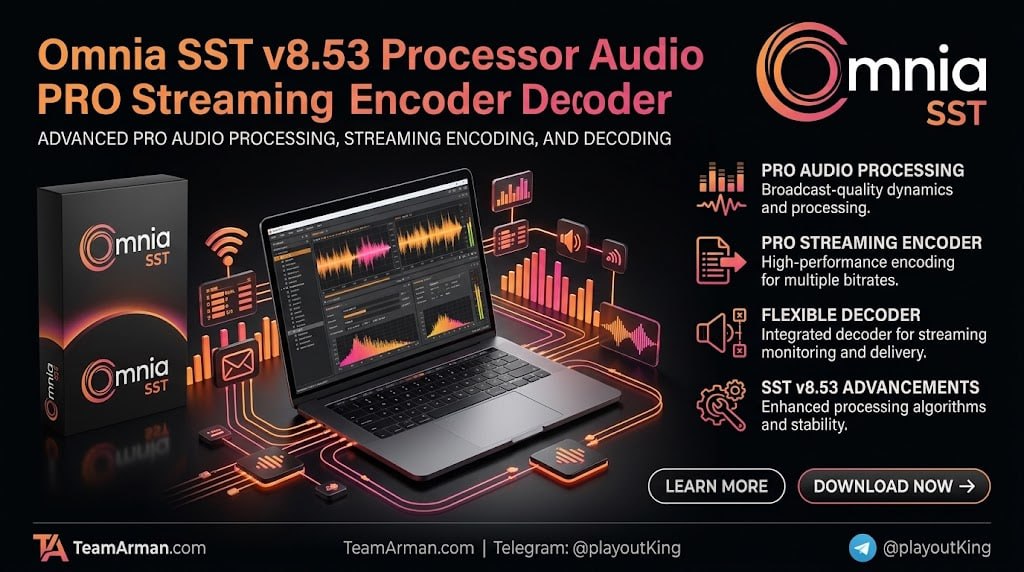
Omnia SST v8.53 is a professional software-based audio processor developed by Telos Alliance that transforms a standard Windows PC into a high-end broadcast audio processor. Designed by audio processing expert Hans van Zutphen in conjunction with the Omnia team, this full-featured software is purpose-built for FM and digital broadcast applications, offering powerful tools to both repair and process audio.
The software is used by radio stations, broadcast engineers, and streaming professionals who need professional-grade audio processing without investing in dedicated hardware processors. Whether you are running a commercial FM station, an internet radio service, or a streaming platform, itT provides the processing power and flexibility required for competitive broadcast audio.
µMPX Codec Support
The software is the first processor to feature the proprietary Omnia µMPX multiplex audio codec, a specialized technology purpose-built for FM radio that allows users to transport high-quality FM multiplex signals and RDS over a narrow 320 kbps IP data pipe, reducing bandwidth needs by 83 percent. This revolutionary codec enables broadcasters to route multiplexed audio and RDS signals directly over IP from the processor to an exciter, opening tremendous possibilities for efficient MPX audio transport.
The v8.53 update includes important µMPX enhancements, including a new packet reception display that allows users to gauge the quality of service of your network connection, integrated directly into the SST user interface. The standalone µMPX decoder and encoder executables are also manageable from the easy-to-use GUI, streamlining the entire workflow for broadcast engineers.
Built-In Encoders And Decoders
It generates and decodes MPX signals directly, eliminating the need for separate hardware stereo coders or RDS encoders. The software includes purpose-built Omnia presets, FM pre-emphasis, stereo and RDS encoding, and shares the same FM reception-improving composite final clipper as found on the flagship Omnia 9SG hardware processor.
This integrated approach significantly reduces equipment costs and rack space requirements while maintaining broadcast-quality output. The software’s ability to handle the entire audio processing chain in a single application makes it an ideal solution for stations transitioning from hardware to software-based processing or for new stations building their infrastructure from scratch.
Advanced Cleaning Tools – The Three Ds For Audio Repair
It is the only processor with the three Ds for your audio needs: Declipper, Delossifer, and Dehummer. The Declipper is a unique filter, also found in the Omnia 9 and 11 flagship processors, that detects and reconstructs clipping-damaged audio caused by too-loud input levels and overly aggressive mastering, prevalent in modern music.
The Delossifer improves the sound of lossy encoded audio, such as MP3 and MPEG2 material, restoring clarity that would otherwise be lost . The Dehummer removes unwanted sounds such as 50/60 Hz hum from bad cables, eliminating noise that can degrade broadcast quality . These remarkable pre-processing tools result in clean, loud, and open sound, ensuring that your broadcast audio sounds professional regardless of the quality of the source material.
Composite Clipper And Flexible Routing
The software includes a composite final clipper that squeezes out extra loudness while keeping upper and lower sidebands symmetrical and compliant with broadcast standards. This clipper, shared with the Omnia 9SG, provides the same FM reception-improving characteristics that have made Omnia processors the choice of leading broadcasters worldwide. Omnia SST also offers flexible routing capabilities, simultaneously outputting pre-emphasized sound, de-emphasized sound, and separate streams.
This means broadcasters can feed multiple destinations from a single processing instance, including the FM transmitter, streaming encoders, and studio monitoring, all with appropriate processing applied for each output type.
v8.53 Update Features – Auto EQ And Improved Anti-Phase Repair
The v8.53 release introduced several significant enhancements that improve the software’s performance and usability. The new Auto EQ feature allows users to automatically control the spectrum before the AGC, making it possible to use the multibands to precisely control how deep each band will go down, and thus how much density can be added to your audio, regardless of how the input material sounds.
Improved anti-phase repair utilizes advanced DSP to allow the restoration and control of pure anti-phase signals, rivalling processors costing thousands more. These improvements make the software even more capable of handling challenging audio sources and delivering consistent, high-quality broadcast output.
System Requirements And Audio Hardware
The software requires a dedicated Windows PC for optimal performance, with a 2.4 GHz Core i3 and 4 GB of RAM as a good starting point, though a 3.6 GHz Core i7 with 8 GB of RAM is recommended for the best results. The software recommends Windows 7 Professional for stability, though Windows 10 can work with some caveats regarding forced updates.
For FM MPX generation, a high-quality sound card capable of 192 kHz sampling rate is essential, preferably with DC-coupled outputs and professional-level balanced I/O. ASIO drivers are preferred for stability and lower latency, and the software supports WDM and ASIO drivers simultaneously. Using an i7 class processor, latency can be reduced to as low as 5ms.
Frequently Asked Questions
Q1: What is Omnia SST v8.53 used for?
It is a professional software-based audio processor that transforms a Windows PC into a high-end broadcast audio processor for FM and digital broadcast applications.
Q2: What is the µMPX codec and what does it do?
µMPX is a specialized audio codec that transports high-quality multiplexed FM signals including RDS over a 320 kbps IP data pipe, reducing bandwidth needs by 83 percent.
Q3: What are the three Ds in Omnia SST?
Declipper (repairs clipped audio), Delossifer (improves lossy compressed audio), and Dehummer (removes 50/60 Hz hum).
Q4: What audio card is required for FM MPX generation?
A high-quality sound card capable of 192 kHz sampling rate with DC-coupled outputs and preferably balanced I/O.
Q5: What are the system requirements for Omnia SST?
A 2.4 GHz Core i3 with 4 GB RAM as a starting point, or a 3.6 GHz Core i7 with 8 GB RAM for optimal performance.
Q6: How is Omnia SST licensed?
License keys are generated using a request code from the software interface and are specific to each hardware installation. The software runs without licensing for evaluation, with recorded messages injected after a period.