Dynamita DYNAMIZU v26.0.0 Dynamic Water Process Simulator for Potable Water and Reuse
Summary
Dynamita DYNAMIZU v26.0.0 is one of the world’s first plant-wide dynamic simulators focused exclusively on water applications, including potable water, effluent reuse, and ultrapure water. Developed by Dynamita as the sister software to their renowned SUMO wastewater model, it simulates advanced water treatment processes and membrane technologies for drinking water, industrial water, and water reuse facilities.
Unlike simpler spreadsheet calculations or empirical design tools, DYNAMIZU uses fundamental biokinetics (Monod expressions) and physical transport to predict effluent quality, chemical consumption, energy usage, and greenhouse gas emissions. The software covers advanced physicochemical and membrane-based treatment technologies, including microfiltration, ultrafiltration (dead-end and cross-flow), reverse osmosis (RO), membrane contactors, electrodeionization (EDI), granular and biologically activated carbon (GAC/BAC), ion exchange columns, ozonation, UV treatment, air stripping, and chemical dosing.
Interface Comparison
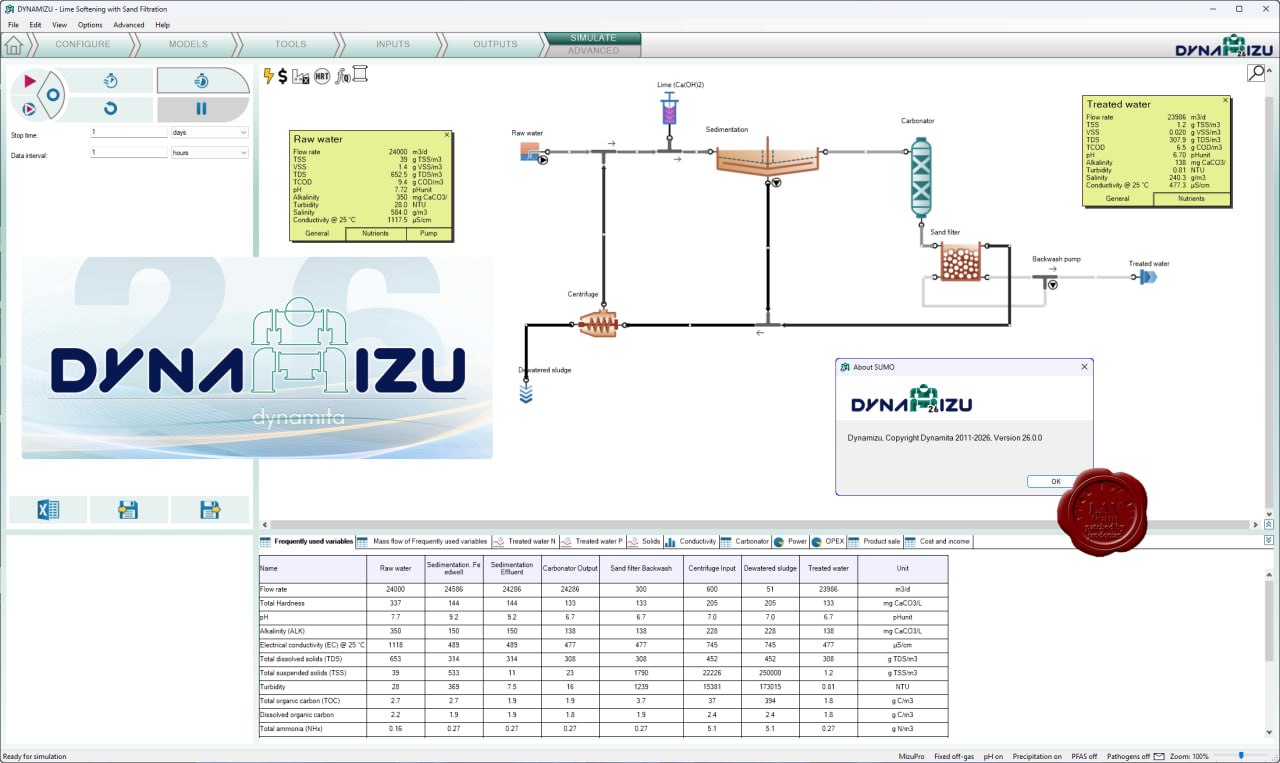
DYNAMIZU uses a task-flow-based graphical user interface designed specifically for Windows 10 and 11. Unlike competing software like GPS-X or WEST that use traditional menu-driven interfaces, DYNAMIZU organizes the workspace around a drawing board where users drag and drop process units, connect them with pipes, and configure parameters through property dialogs.
The drawing board includes mass flow displays and annotations directly on the canvas. This means you can see flow rates, concentrations, and loading rates without opening separate dialogs. For presentations or reports, the drawing board is publication-ready screenshots can be used directly in documents without additional formatting.
Speed And Optimization
DYNAMIZU is optimized for speed. The compiled models are platform-independent and run efficiently on modern Windows hardware. For a typical municipal wastewater treatment plant model (activated sludge with nutrient removal), a 365-day dynamic simulation with 15-minute timesteps completes in 60-120 seconds on a standard workstation.
The software includes a steady-state solver that converges quickly for design calculations. Most steady-state simulations complete in under 5 seconds, allowing rapid iteration of design alternatives.
The multi-scenario manager is a significant productivity feature. Instead of running simulations sequentially, you can set up 10 or 20 design alternatives (different tank sizes, different aeration strategies, different chemical doses) and run them all in a single batch. Results are displayed side-by-side for comparison. This reduces optimization time from days to hours.
Creative Flexibility
DYNAMIZU’s defining feature is its open-source modeling approach. All model source code is visible and editable. Models are coded in SumoSlang, Dynamita’s intuitive simulation language, in Excel tabular format. This means users can modify any existing model or create entirely new models for specialized processes.
If DYNAMIZU does not have a specific process unit you need, you can build it yourself. If you need to modify the ASM2d BioP model to include a new metabolic pathway, you can edit the equations directly. This is not possible in competing simulators where models are compiled and hidden.
The software includes a model editor with automated mass balance checking. When you add a new process or modify an existing one, the editor verifies that mass is conserved no carbon, nitrogen, or phosphorus is created or destroyed. This prevents common modeling errors.
Control elements include PID controllers, deadband controllers, timers, on-off switches, and ratio controllers. Flow control elements include pumps, bypass weirs, channels, equalization basins, flow combiners, and dividers. Chemical dosing units support polymers, metal salts, acid, base, buffers, and disinfectants.
Advanced Functions
- Activated Sludge Models (ASM) Implementation: DYNAMIZU implements all major activated sludge models including ASM1 (COD removal, nitrification, denitrification, OUR), ASM2d (chemical phosphorus removal, BioP with PAO/GAO, fermentation), ASM2d + Anammox (mainstream deammonification for low COD/N), ASM2d + BioP (enhanced biological phosphorus removal with PAO, GAO, P-release/uptake), and ASM3 (storage polymers X_STO, endogenous respiration).
- Secondary Settling and Clarifier Models: The software includes the Takács 1D model (10 layers with hindered and compression settling), Otterpohl and Freund models, and flocculent settling (dynamic). Secondary settler modeling is critical for predicting solids loading, return activated sludge concentration, and waste activated sludge production.
- Aeration and Oxygen Transfer: DYNAMIZU calculates specific oxygen uptake rate (SOUR), oxygen uptake rate (OUR), oxygen transfer efficiency (OTE), and includes clean water vs. process water correction (α, β, F factors). Both fine bubble and coarse bubble aeration systems are supported.
- Energy and Greenhouse Gas (N₂O): Version v26.0 introduces an N₂O emission module compatible with IPCC Tier 3 reporting. Nitrous oxide is a potent greenhouse gas (approximately 300x CO₂ equivalent). The module accounts for nitrifier denitrification and the AOB pathway. Pumping and mixing energy scales with flow, and the software produces carbon footprint reports.
- Membrane Systems: DYNAMIZU includes detailed models for microfiltration (MF), ultrafiltration (UF dead-end and cross-flow), reverse osmosis (RO), membrane contactors, and electrodeionization (EDI). These are not black-box models; they include fouling, cleaning cycles, and energy consumption.
- Ion Exchange and Adsorption: The software simulates cation exchangers, anion exchangers, mixed bed ion exchangers, granular activated carbon (GAC), and biological activated carbon (BAC). Breakthrough curves, regeneration cycles, and capacity depletion are modeled.
Similar Tools
| Software | Primary Focus | Key Difference from DYNAMIZU |
|---|---|---|
| DYNAMIZU | Potable water, reuse, ultrapure | Open source code, water-focused, membrane models |
| SUMO | Wastewater treatment | Wastewater focus, same interface, same company |
| GPS-X | Wastewater treatment | Closed models, subscription pricing |
| WEST | Wastewater treatment | Closed models, academic focus |
| BioWin | Wastewater treatment | User-friendly, less flexible |
| Python/Matlab custom | Research | Free but requires coding, no built-in unit models |
DYNAMIZU vs. SUMO: DYNAMIZU is the water-focused sister software to SUMO. DYNAMIZU covers drinking water, reuse, ultrapure, and membrane processes. SUMO covers wastewater treatment. The two can be integrated for total “OneWater” modeling. If you bundle both, you receive a 20% discount on DYNAMIZU.
DYNAMIZU vs. GPS-X: GPS-X is a wastewater simulator with closed-source models. Users cannot modify the underlying equations. DYNAMIZU’s models are open source you can see and edit every equation.
DYNAMIZU vs. BioWin: BioWin is more user-friendly for beginners but less flexible. DYNAMIZU offers more advanced features (N₂O emissions, membrane models, ion exchange) and open-source customization.
Strengths And Weaknesses
Strengths:
- Open-source model code is the biggest differentiator. Users can modify existing models or create new ones.
- This is not possible in any competing water/wastewater simulator.
- DYNAMIZU covers the complete water treatment spectrum: potable water, reuse, ultrapure, and (with SUMO) wastewater. No other simulator offers this breadth.
- Membrane models (MF, UF, RO, EDI) are detailed and process-specific, not generic separators.
- Ion exchange and GAC/BAC models include breakthrough and regeneration.
- The multi-scenario manager allows comparing 10+ design alternatives simultaneously.
- This is a significant productivity tool for process design.
- N₂O emission modeling (v26.0) is ahead of competitors, supporting IPCC Tier 3 reporting for carbon footprint.
Weaknesses:
- The learning curve is steeper than BioWin or GPS-X. Users without modeling experience will need training.
- The user interface, while functional, is less polished than commercial software from larger vendors.
- Excel is required for the Model Editor. This is a limitation for users without Microsoft Office.
- DYNAMIZU runs on Windows only (though it runs on Mac within Parallels). No native Linux or macOS version.
- Pricing is not publicly listed; users must request quotes.
- This is typical for professional engineering software but inconvenient for quick comparison.
User Experience
Dynamita DYNAMIZU is designed for professional engineers, not casual users. The learning curve is moderate for experienced process engineers familiar with ASM models and wastewater treatment principles. Beginners will need formal training. Dynamita offers training online, at their offices, or at client locations.
The task-flow-based interface is intuitive once you understand the logic: drag process units onto the drawing board, connect them, double-click to configure, run simulation, view results. The mass flow displays on the drawing board provide immediate feedback without navigating to separate results windows.
For large projects, DYNAMIZU connects to digital twin technology (additional cost). This allows real-time optimization of operating plants using the same models developed during design.
Final Verdict
Dynamita DYNAMIZU is the most flexible and comprehensive water treatment process simulator available. The open-source model code is a significant advantage over competitors. If you need to model a standard activated sludge plant, any simulator will work. If you need to model a unique process, develop new model formulations, or customize existing models, only DYNAMIZU allows that.
Who should buy DYNAMIZU: Engineering consulting firms specializing in water treatment design. Researchers developing new treatment technologies. Utilities with complex treatment trains that off-the-shelf simulators cannot represent. Academics teaching advanced process modeling.
Who can use alternatives: Engineers who only need standard activated sludge modeling may find BioWin or GPS-X sufficient. Organizations without modeling expertise may prefer the simpler interfaces of other tools. Budget-constrained users may consider open-source alternatives (though none offer DYNAMIZU’s unit process library).