Virtual Audio Cable (VAC) 4.71 [Full Retail Version] Professional Best Audio Routing Software
Summary
Virtual Audio Cable (VAC) v4.71 is a highly efficient multimedia utility designed to create an internal loopback network of virtual audio playback and recording endpoints on Windows systems. Developed by independent software engineer Eugene V. Muzychenko, this tool acts as a digital patch bay, enabling bit-perfect audio stream transmission between disparate applications in real time without the need for physical hardware modifications.
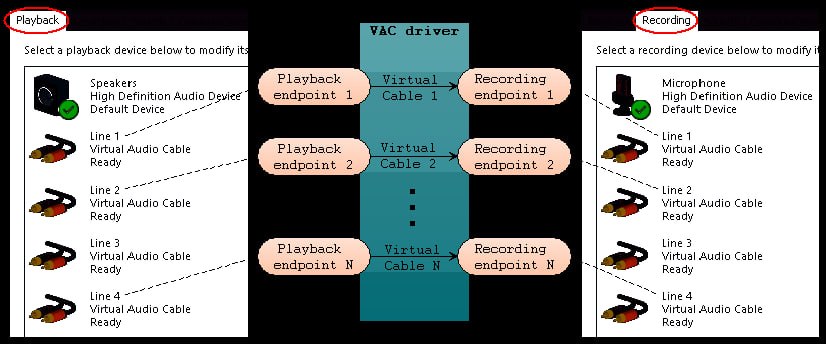
VAC creates a set of virtual audio devices where each device simulates an audio adapter whose output is internally connected to the input, making an audio loopback. If an application plays audio to the output of such device, the sound is looped back to the input where another application can record from it.
How Virtual Audio Cable Works – The Core Concept
Each side of any Virtual Cable can be used by several audio apps at the same time. If two or more apps play sounds to the same playback endpoint, these sounds are mixed, and the result is transmitted to the recording side. If two or more apps record from the same endpoint, each app gets a copy of the sound. Therefore, each Virtual Cable acts as a meeting point or a logistics hub for applications.
The driver and Virtual Cable endpoints work together to create a seamless audio routing environment. Actual names of virtual audio devices that you will see in applications’ menus are different, such as “Line 1”, “Line 2”, etc. The term “Virtual Cable” is used only in the description of VAC product as a placeholder.
Core Technical Changes In v4.71
The v4.71 production branch implements several critical driver and interface refinements. WaveRT Buffering Drivers introduce adjustable minimum Real-Time Audio (WaveRT) buffer factors, forcing clients to use larger, stable buffer pools to eliminate crackling and dropouts on heavy CPU loads. Control Panel Endpoints adds native endpoint mapping labels directly inside the main Cable Information View, allowing easier tracking of default system audio paths.
Filter API Queries enhances driver-level programmatic access, allowing automation utilities to poll active audio filters and patch configurations directly. Audio Repeater Updates expands the integrated Audio Repeater KS utility to support strict pin index commands via headless command-line calls.
Primary Operational Use Cases
VAC enables several important audio routing scenarios. Bit-Perfect Signal Routing passes uncompressed digital audio streams directly across apps without introducing quality degradation or unintended volume scaling. Multi-Application Mixing allows multiple independent programs to concurrently write to a single playback channel, automatically mixing the combined inputs cleanly into the targeted recording side.
Headless Server Emulation provides a functional virtual sound card architecture for remote servers and virtual machines that lack physical audio processors. VAC delivers audio signals completely inside the computer with no audio hardware required, making it suitable for virtual servers with no audio adapter.
Audio Repeater And Signal Routing
To transfer and route audio signals from an endpoint to another, VAC offers the Audio Repeater application. This utility acts as the bridge between virtual cables and physical audio devices. Users can route audio from a virtual cable to physical speakers, from a physical microphone to a virtual cable, or between two virtual cables. The Audio Repeater supports various audio formats and sample rates, ensuring compatibility across different applications.
It can run in the background with minimal system resource usage. The v4.71 update expands the Audio Repeater KS utility to support strict pin index commands via headless command-line calls, enabling automation and scripting scenarios.
System Compatibility And Technical Specifications
VAC works across a wide range of Windows operating systems. OS Deployment includes native 32-bit and 64-bit architecture support running continuously across Windows XP, 7, 8, 10, and Windows 11 environments. Interface Standards are fully compatible with native Windows Multimedia (MME), DirectSound, Kernel Streaming (KS), and WASAPI audio layer endpoints.
There is no quality loss when no format conversion or volume control is involved. If all these conditions are met, audio transfer is bitperfect, suitable for audiophile applications. In well-tuned systems, signal latency is very low. The software never guides you to advertising pages, nor busily pops up on the screen, nor installs hidden activities in your system.
Security Alert About Unofficial Downloads
If you are looking at an online package titled “Virtual Audio Cable (VAC) 4.71 [Full Retail Version]” on file-sharing repositories or third-party index sites, there are significant risks. High Malware Risk exists because these pre-packaged installers frequently bundle deep-level Trojan downloaders or spyware designed to gain administrative control over host systems.
Corrupted Digital Signatures occur because VAC operates as a kernel-mode device driver, and cracked or bypassed variants often alter binary signatures, causing Windows to trigger Kernel Security Check Failure blue screen errors or refuse boot sequences entirely due to Driver Signature Enforcement blocks. Official Verification requires genuine, secure deployments obtained strictly via the official Virtual Audio Cable Download Portal.
Applications And Use Cases
VAC works with a wide range of audio applications and application classes. Internet Telephony and VoIP applications like Skype, Discord, Ventrilo, and MicroSIP benefit from VAC’s routing capabilities. Live mixing and DJ software such as vMix, Mixxx, VirtualDJ, and VoiceMeeter Banana integrate seamlessly. Live broadcasting tools like Open Broadcaster (OBS Studio), WireCast, VidBlasterX, and SAM Broadcaster use VAC for audio routing.
Software synthesizers and studio DAWs including Ableton, Acid, Cakewalk, Cubase, FL Studio, REAPER, and Reason are fully compatible. Audio editors and recorders like Audacity, Adobe Audition, GoldWave, and Sound Forge work with VAC. Virtual Machines including VMware Player, Workstation, VirtualBox, and Hyper-V can also use VAC for audio routing.
FAQ
Q1: What is Virtual Audio Cable (VAC) 4.71?
It is a multimedia utility that creates virtual audio devices for routing audio streams between applications on Windows systems.
Q2: How does VAC work?
VAC creates virtual audio devices where output is internally connected to input, creating an audio loopback for applications to route audio between them.
Q3: Is VAC suitable for audiophile applications?
Yes. If no format conversion or volume control is involved, audio transfer is bitperfect with no quality loss.
Q4: What are the system requirements for VAC 4.71?
VAC runs on Windows XP, 7, 8, 10, and 11 with native 32-bit and 64-bit support.
Q5: What audio interfaces does VAC support?
VAC is compatible with Windows Multimedia (MME), DirectSound, Kernel Streaming (KS), and WASAPI audio layers.
Q6: Can multiple applications use the same virtual cable?
Yes. Multiple apps can play to the same playback endpoint with mixing, and multiple apps can record from the same endpoint with copies.
Q7: Does VAC work without physical audio hardware?
Yes. VAC delivers audio signals completely inside the computer with no audio hardware required.
Q8: Is there a free version of VAC available?
Yes. A free Lite edition is available for home environments on the official website.
Q9: What is the Audio Repeater in VAC?
Audio Repeater is a utility that transfers and routes audio signals between endpoints, supporting headless command-line calls.
Q10: Where can I safely download VAC 4.71?
Download exclusively from the official Virtual Audio Cable Download Portal to avoid malware and corrupted signatures.
Technical Specifications
| Specification | Details |
|---|---|
| Software Name | Virtual Audio Cable (VAC) 4.71 |
| Category | Audio Routing and Virtual Audio Device Software |
| Developer | Eugene V. Muzychenko |
| Primary Use | Internal audio stream routing between applications |
| Audio Interfaces | MME, DirectSound, KS, WASAPI |
| Operating Systems | Windows XP, 7, 8, 10, 11 (32-bit and 64-bit) |
| Key Features | Bit-perfect routing, multi-application mixing, Audio Repeater |
| Quality | Bit-perfect with no format conversion or volume control |
| License Type | Commercial (Lite edition available) |