Cadence Fidelity Pointwise 2025.2.4 (x64) CFD Mesh Generation Software
Summary
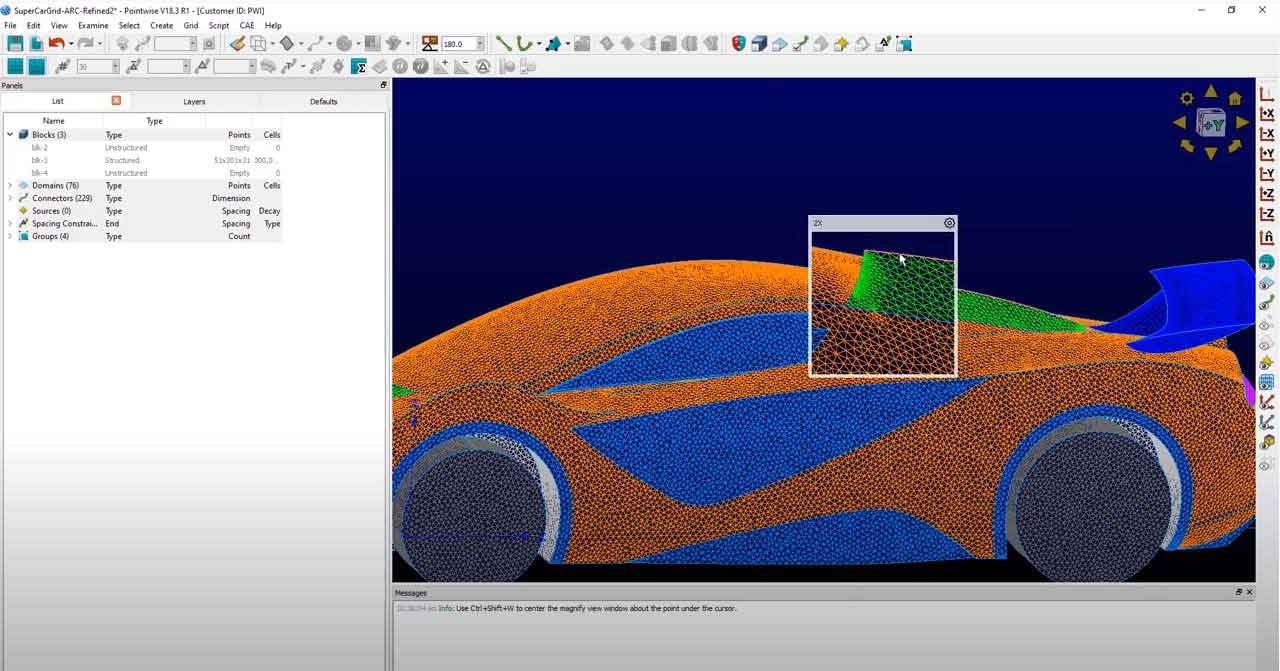
Cadence Fidelity Pointwise 2025.2.4 (x64) is a highly specialized pre-processing and mesh-generation software built for Computational Fluid Dynamics (CFD). Developed by Cadence Design Systems, this 64-bit platform provides aerodynamicists and engineers with precise structural control over the creation of structured, unstructured, and hybrid 3D meshes for fluid simulations.
Fidelity Pointwise is used worldwide in aerospace, automotive, marine, power generation, chemical process, and many other industries for which CFD is an integral part of the design process. The software recognizes that meshing is a crucial yet time-consuming part of the CFD workflow, offering industry-leading mesh generation techniques that seamlessly integrate with any CFD simulation workflow.
Why Mesh Quality Matters In Computational Fluid Dynamics
Generating meshes for computational fluid dynamics is the most important step in the flow modelling process. It is where you have the most influence on how fast, how converged, and how accurate your solution will be. A poor quality mesh leads to inaccurate results, slow convergence, and wasted computational resources. A high-quality mesh captures flow features accurately, converges quickly, and provides reliable results.
Fidelity Pointwise delivers mesh generation that is flexible, reliable, and of the highest quality. The software balances resolution and cell shape metrics catering to specific flow solver requirements. Engineers trust Fidelity Pointwise because it gives them control over the mesh quality at every stage of the process, from initial geometry import to final solver export.
Key Capabilities In The 2025.2 Release Lifecycle
The 2025.2.4 build pipeline incorporates major usability upgrades and fluid domain refinement techniques. The Refinement Buffer introduces a constant-sized isotropic cell region directly around T-Rex boundary conditions, eliminating the need to stack multiple manual geometry sources and allowing drastically faster wake mesh refinements. Assisted Model Assembly (AMA) Upgrades feature a built-in detection workflow designed to spotlight sliver surfaces, which are extremely thin or imperfect CAD faces that traditionally break surface mesh generation or prevent watertight model creation.
The overhauled Boundary Conditions UI implements a reorganized layout for CAE environments, making it faster to assign, merge, clean up, and track boundary entities on complex geometries. CAE Volume Conditions streamline multi-field or conjugate heat transfer setups by isolating fluid versus solid volumes and assigning porous or sponge zones prior to exporting to solvers.
Mesh Types And Generation Techniques
Fidelity Pointwise offers industry-leading mesh generation techniques for various mesh types. Structured grids provide precise control and are ideal for simple geometries with predictable flow patterns. Unstructured meshes offer flexibility for complex geometries where structured grids are impractical. Hybrid meshes combine the best of both approaches, using structured grids in critical regions and unstructured grids elsewhere.
T-Rex (Anisotropic Tetrahedral Extrusion) technology enables the generation of high-quality boundary layer meshes with minimal user intervention. The software supports hybrid, overset, and high-order meshes, enabling explorative examination with cell definitions for meshes up to billions of cells. Users can balance resolution and cell shape metrics catering to specific flow solver requirements.
Geometry Model Preparation And Repair
Fidelity Pointwise includes powerful geometry model preparation capabilities. The software works with B-Rep NURBS, digital geometry forms, 3D scans, and other sources. The Assisted Model Assembly (AMA) technology helps repair and prepare CAD models for meshing. The detection workflow identifies sliver surfaces that traditionally break surface mesh generation. Users can repair, simplify, and prepare geometries directly within the software environment. The goal is to create a watertight, manifold geometry ready for high-quality mesh generation. This capability is essential for handling complex industrial geometries that come from various sources with different levels of quality.
Solver Interoperability And Export Options
Fidelity Pointwise integrates into any CFD simulation workflow. Once a high-fidelity mesh is complete, it natively exports grid configurations to mainstream solvers like ANSYS Fluent, OpenFOAM, Star-CCM+, and Cadence’s own accelerated Fidelity Flow Solver. The software provides mesh export and import tools and pre-built relationships with other strong solvers and simulation tools.
Users can trust that Fidelity Pointwise will enhance existing workflows without requiring major changes to established processes. The export process ensures that mesh quality is preserved when transferred to solvers, maintaining the accuracy and convergence benefits achieved during mesh generation.
Fidelity CFD Platform Integration
Fidelity Pointwise is part of the larger Cadence Fidelity CFD Platform. The platform provides an easy-to-use, end-to-end CFD solution for multidisciplinary design and optimization in applications such as aerospace, automotive, turbomachinery, and marine industries. The platform features streamlined workflows, massively parallel architecture, and state-of-the-art solver technology. It provides unprecedented performance and accuracy, increasing engineering efficiency for today’s design challenges.
The Fidelity Charles Solver slashes turnaround times from days to hours with its high-fidelity CFD solver. Fidelity Fine Design3D leverages machine learning for unparalleled design optimization. The Fidelity CFD Platform accelerates all steps of the design process, providing more than 10X acceleration across all steps of the simulation process for faster time to results.
Applications Across Industries
Fidelity Pointwise is used across multiple industries requiring CFD analysis. In aerospace, it addresses simulations of various aircraft configurations ranging from subsonic, transonic, and supersonic regimes. Engineers use it for aerodynamic forces prediction and flow separation analysis in complex configurations. In automotive, it supports external aerodynamics, underhood thermal management, and aeroacoustics simulations.
In marine, it handles hydrodynamics, propeller design, and vessel resistance analysis. In turbomachinery, it supports compressor, turbine, and pump simulations. In biomedical, it assists with blood flow analysis and medical device design. The software’s versatility makes it suitable for any application requiring high-quality CFD meshes.
System Requirements And Hardware Specifications
To handle modern multi-million cell grids inside the 2025 branch, the workstation should align with specific requirements. The operating system must be 64-bit Windows 10, Windows 11, or supported enterprise Red Hat or SUSE Linux distributions. The hardware architecture should be a multi-core x86-64 processor utilizing parallelized computing resources to accelerate boundary layer generation.
A dedicated OpenGL-compliant graphics card is recommended, with NVIDIA Quadro or AMD Radeon Pro recommended to prevent viewport lag during heavy 3D spatial rotation. Sufficient RAM is essential for handling large meshes, with 32 GB or more recommended for complex models. Solid-state storage improves file loading and saving times for large projects.
FAQ
Q1: What is Cadence Fidelity Pointwise 2025.2.4?
It is a specialized pre-processing and mesh-generation software for Computational Fluid Dynamics (CFD), developed by Cadence Design Systems.
Q2: What types of meshes can Fidelity Pointwise generate?
It generates structured, unstructured, hybrid, overset, and high-order meshes for fluid simulations.
Q3: What is T-Rex mesh generation?
T-Rex (Anisotropic Tetrahedral Extrusion) technology generates high-quality boundary layer meshes with minimal user intervention.
Q4: What solvers are compatible with Fidelity Pointwise?
It exports to ANSYS Fluent, OpenFOAM, Star-CCM+, Cadence Fidelity Flow Solver, and many others.
Q5: What are the system requirements for 2025.2.4?
64-bit Windows 10, 11, or Linux. Multi-core x86-64 processor, dedicated OpenGL graphics card, and sufficient RAM for large meshes.
Q6: What is the Refinement Buffer in 2025.2.4?
It is a constant-sized isotropic cell region around T-Rex boundary conditions that enables faster wake mesh refinements.
Q7: What is Assisted Model Assembly (AMA)?
It is a built-in detection workflow that identifies sliver surfaces and helps repair CAD models for meshing.
Q8: What industries use Fidelity Pointwise?
Aerospace, automotive, marine, turbomachinery, power generation, chemical process, and biomedical industries.
Technical Specifications Summary
| Specification | Details |
|---|---|
| Software Name | Cadence Fidelity Pointwise 2025.2.4 (x64) |
| Category | CFD Mesh Generation Software |
| Developer | Cadence Design Systems |
| Primary Use | Pre-processing and mesh generation for CFD simulations |
| Mesh Types | Structured, unstructured, hybrid, overset, high-order |
| Key Features | T-Rex meshing, AMA, Refinement Buffer, solver export |
| Solvers Supported | ANSYS Fluent, OpenFOAM, Star-CCM+, Fidelity Flow Solver |
| Operating Systems | Windows 10, 11, Linux (Red Hat, SUSE) |
| License Type | Commercial |