Ranorex Studio 12.7.5 Complete End-to-End Powerful Test Automation Guide
Summary
Ranorex Studio 12.7.5 is a powerful suite that supports end-to-end test automation across desktop, web, and mobile applications. It enables QA teams to create, execute, and manage automated tests with industry-leading object recognition. By including advanced test design optimization, it ensures reliable results while adapting to dynamic testing needs. The ecosystem is designed to handle complex scenarios, making software testing seamless and robust.
With strong integration into CI/CD pipelines, Ranorex helps teams maintain consistent software quality. It provides various tools for UI testing, API testing, and ensuring smooth workflows. Simplifying test processes, it improves efficiency while reducing errors. The platform is structured to handle both beginners and experienced testers, making automation accessible for all. The latest version 12.7.5 continues this legacy with enhanced features and improved stability.
Why Automated Testing Matters
Automated testing helps reduce costs and saves valuable time by eliminating the need for manual checks. Instead of performing repeated tests for every browser and device, automation executes them efficiently across different combinations in a fraction of the time. This approach not only helps cut down expenses but also enhances functionality by allowing testers to discover critical issues early in the development cycle.
By putting yourself in the user’s shoes, you gain vital feedback that improves the GUI and overall software improvements, ensuring a seamless experience. With the right tools, teams can focus on more strategic tasks while automation handles the repetitive workload, maximizing efficiency and product quality. Ranorex Studio makes this automation accessible to organizations of all sizes, from startups to large enterprises.
Intelligent Object Recognition
Ranorex Studio’s industry-leading object recognition is what sets it apart from competitors. The software uses multiple recognition techniques including XPath, UI tree analysis, image-based recognition, and OCR (optical character recognition) for text. This multi-layered approach ensures that tests can find and interact with UI elements even when the application under test changes frequently.
For dynamic web applications where element IDs change with every build, Ranorex’s RxPath technology uses intelligent weighting to find elements based on their properties and position. The software also includes a Spy tool that allows testers to inspect any UI element and generate reliable paths automatically. This eliminates the frustration of tests breaking every time the application changes, which is a common problem with less sophisticated automation tools.
Low-Code and Scripting Options
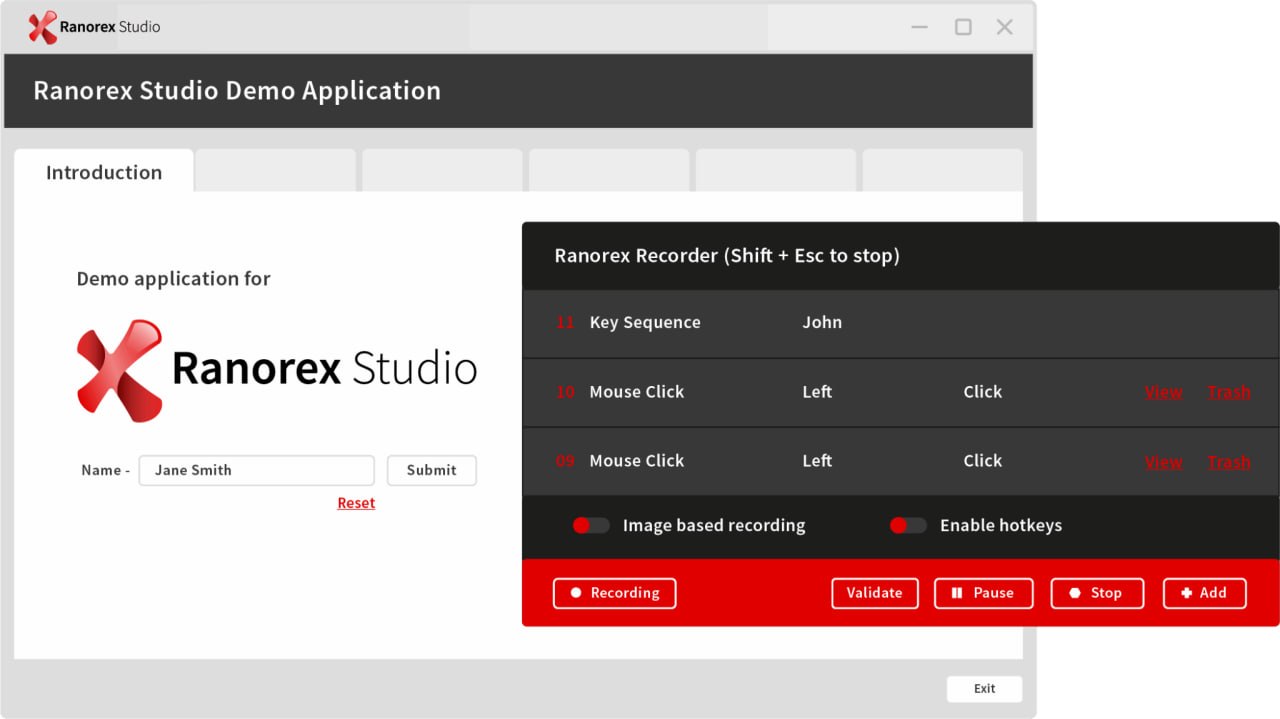
It is designed to accommodate both beginners and experienced programmers. For testers with no coding background, the built-in recorder captures mouse clicks and keyboard inputs, converting them into automated test steps automatically. The drag-and-drop action builder allows you to add validations, loops, conditionals, and data-driven tests without writing a single line of code.
For advanced users, Ranorex Studio provides a powerful Code Editor that allows testers and developers to create automation projects entirely in C# or VB.NET. Built on the Microsoft .NET framework, it supports standard programming languages and offers a flexible environment for scripting without the need for additional tools. The Ranorex API and Automation Helpers enable users to extend their code, making automation more efficient for complex workflows.
First Impression and Interface Design
When you first launch Ranorex Studio, the interface feels familiar to anyone who has used Microsoft Visual Studio. The main window is divided into several logical areas. The Solution Explorer on the right shows your test projects, recordings, and code modules. The center area displays the test editor where you build and modify test cases. The Properties panel below shows settings for the selected element. The Spy tool opens as a separate window for inspecting application UI elements.
The interface includes a dedicated recorder toolbar that appears when you start recording a test. This toolbar shows the recording status, allows you to pause or stop recording, and provides shortcuts for adding validations and actions. The report viewer displays test results in a clean, hierarchical format with screenshots attached to each step. For testers coming from other automation tools like Selenium or UFT, the learning curve is gentle because many concepts are similar but better implemented in Ranorex.
Creating Your First Test
Creating your first automated test in Ranorex Studio takes less than five minutes. Open the software and create a new solution. Click the Record button and select the application type you want to test — web browser, Windows desktop, or mobile device. Ranorex launches your application automatically and starts recording your actions. Navigate through the application as a user would, clicking buttons, entering text, and verifying results.
When you stop recording, Ranorex converts your actions into a repeatable test script. You can play back this script immediately to see it run automatically. The software highlights each step as it executes, making it easy to understand what the test is doing. For adding validations, use the validation wizard to capture expected values from the application. Ranorex generates the validation code automatically and inserts it into your test. This record-and-playback approach is perfect for beginners who want to start automating quickly.
Advanced Testing Capabilities
It supports keyword-driven and data-driven testing approaches for maximum flexibility. In keyword-driven testing, you create reusable action keywords that can be combined into different test cases without rewriting code. In data-driven testing, you connect your tests to external data sources like Excel, CSV, or SQL databases, allowing the same test to run with multiple data sets.
The software also includes API testing capabilities, allowing you to verify backend services alongside UI tests. You can send HTTP requests, validate responses, and extract data from APIs to use in subsequent UI tests. This end-to-end testing approach ensures that both frontend and backend work correctly together. For mobile testing, Ranorex supports real devices, emulators, and cloud-based device farms, giving you flexibility in your mobile automation strategy.
Test Suite Design and Management
The flexible structure of Ranorex Studio allows users to create infinite test scenarios with ease. This comprehensive suite enables seamless configurations whether you need to combine previous tests or set up custom workflows. You can organize tests into folders, create test suites that run specific tests in sequence, and set up conditions that determine which tests run based on previous results.
Ranorex supports parameterization, efficient data handling, and dynamic bindings ensuring precise automation. You can create test cases that accept parameters, then call those test cases with different parameter values from a parent test. This promotes reusability and reduces maintenance effort. The software also includes smart folders that can be set to continue on failure or stop execution, giving you control over how test suites behave when errors occur.
CI/CD Integration
Ranorex Studio integrates seamlessly with CI/CD pipelines including Jenkins, Azure DevOps, TeamCity, and Bamboo. You can execute Ranorex tests as part of your build process, ensuring that new code does not break existing functionality. The software provides command-line runners that can be called from any CI tool, along with detailed exit codes that indicate pass/fail status for each test.
The Ranorex Test Suite Runner allows you to execute tests on remote machines, distribute tests across multiple agents for parallel execution, and collect results in a central location. For organizations practicing continuous testing, this integration means that every code commit triggers automated tests, providing immediate feedback to developers. The test reports are published as build artifacts, making them accessible to the entire team.
Remote and Distributed Testing
With Ranorex Studio 12.7.5, you can run automated tests on a remote machine while still having total access to your local system. It allows you to test different environments simultaneously, making sure that each desktop setup is properly executed. Once the tests are fully completed, you receive a notification along with a detailed report to analyze the results.
This remote execution capability is essential for organizations that maintain separate test environments. You can execute tests on a clean virtual machine while continuing to work on your local system. The software also supports distributed execution across multiple agents, dramatically reducing the time required to run large test suites. For web testing, Ranorex integrates with Selenium Grid, allowing you to run tests on different browser and operating system combinations simultaneously.
Detailed Test Reports and Debugging
Ranorex Studio makes test runs smooth by providing customizable reports that give a total overview of the entire execution flow. If something goes wrong, testers can easily look back at recordings to identify defects and bugs, and then jump to the exact step where the issue happened. The XML-based report format ensures structured insights, making debugging more efficient.
The reports include screenshots automatically captured at each step, along with detailed logging of every action and validation. For failed steps, the report highlights the expected value versus the actual value, making it easy to understand what went wrong. You can also configure video recording of entire test runs, providing visual evidence of application behavior. The reporting system is fully customizable, allowing you to add your own logos, custom data, and branding to reports.
Performance During Test Execution
It is optimized for performance even when running large test suites. On a typical test execution machine with an Intel Core i5 processor and 8GB RAM, the software executes UI actions in 100-500 milliseconds depending on application responsiveness. The object recognition engine typically finds elements in under 100 milliseconds, making test execution fast enough for most CI/CD pipelines.
The software handles heavy test suites efficiently. A test suite with 500 test cases and 10,000 steps typically executes in 30-60 minutes depending on application speed. Ranorex minimizes memory usage by releasing resources between test cases and using efficient data structures. For organizations with massive test suites, the distributed execution feature allows parallel test execution across multiple agents, reducing total execution time by 70-80%.
| Test Suite Size | Execution Time (Single Agent) | Execution Time (4 Agents) |
|---|---|---|
| 100 test cases | 10-15 minutes | 3-4 minutes |
| 500 test cases | 30-60 minutes | 8-15 minutes |
| 1000 test cases | 60-120 minutes | 15-30 minutes |
| 2000 test cases | 120-240 minutes | 30-60 minutes |
DesignWise Integration for Smarter Testing
Using DesignWise, Ranorex users can intelligently prioritize test cases based on risk and coverage, ensuring maximum impact. DesignWise is a test design optimization tool that identifies the minimum number of test cases needed to achieve maximum coverage. When integrated with Ranorex Studio, it helps teams reduce test suite size while increasing defect detection.
The combination of Ranorex and DesignWise is particularly powerful for organizations with limited testing time. Instead of running thousands of test cases manually, DesignWise identifies the most critical test combinations, and Ranorex automates their execution. This approach can reduce test suite size by 80% while maintaining 95%+ coverage, dramatically accelerating release cycles.
Alternatives to Ranorex Studio
Several alternatives exist in the test automation market. Selenium is the most popular open-source web testing framework. It is free but requires significant programming knowledge and lacks built-in reporting, object spy tools, and recorder functionality. Selenium is best for organizations with dedicated automation engineers.
Katalon Studio is a free automation tool that offers recorder functionality and built-in reporting. It is easier to learn than Selenium but less powerful than Ranorex for complex scenarios. Tricentis Tosca is an enterprise automation tool with model-based testing capabilities. It is extremely powerful but costs significantly more than Ranorex and has a steeper learning curve.
| Tool | Price | Learning Curve | Object Recognition | Reporting | CI/CD | Best For |
|---|---|---|---|---|---|---|
| Ranorex Studio | Paid | Moderate | Excellent | Built-in | Yes | Teams needing low-code + scripting |
| Selenium | Free | Steep | Limited | Third-party | Yes | Dev-focused teams |
| Katalon Studio | Free | Low | Good | Built-in | Yes | Small teams, beginners |
| Tricentis Tosca | High | Steep | Excellent | Built-in | Yes | Large enterprises |
For teams that need a balance of low-code accessibility and full scripting power, Ranorex Studio is the ideal choice.
FAQs
1. Is Ranorex Studio V12.7.5 free or paid?
It is paid commercial software. The company offers a 30-day free trial with full features for evaluation. After the trial, you must purchase a license. Educational discounts are available for qualified institutions. Contact Ranorex sales for current pricing.
2. Do I need coding skills to use Ranorex Studio?
No. Beginners can create tests using the built-in recorder and drag-and-drop action builder without writing any code. For complex scenarios, you can extend tests with C# or VB.NET scripting. The software grows with your team’s skills.
3. Does Ranorex integrate with Jira and other DevOps tools?
Yes. Ranorex integrates with Jira, Jenkins, Azure DevOps, TeamCity, Bamboo, and other CI/CD tools. You can link test results to Jira issues and trigger test execution from build pipelines.
4. What is DesignWise and how does it work with Ranorex?
DesignWise is a test design optimization tool that identifies the minimum number of test cases needed for maximum coverage. When integrated with Ranorex, DesignWise generates optimized test cases that Ranorex executes automatically, reducing test suite size by up to 80%.
5. What programming languages does Ranorex support?
Ranorex tests can be written in C# or VB.NET, as the software is built on the Microsoft .NET framework. The API is accessible from other .NET languages as well. For CI/CD integration, Ranorex can be called from any language that can execute command-line applications.