EdrawMax (15.2.1.1532) Complete Tutorial for Smart AI-Powered Diagramming
by admin · June 3, 2026
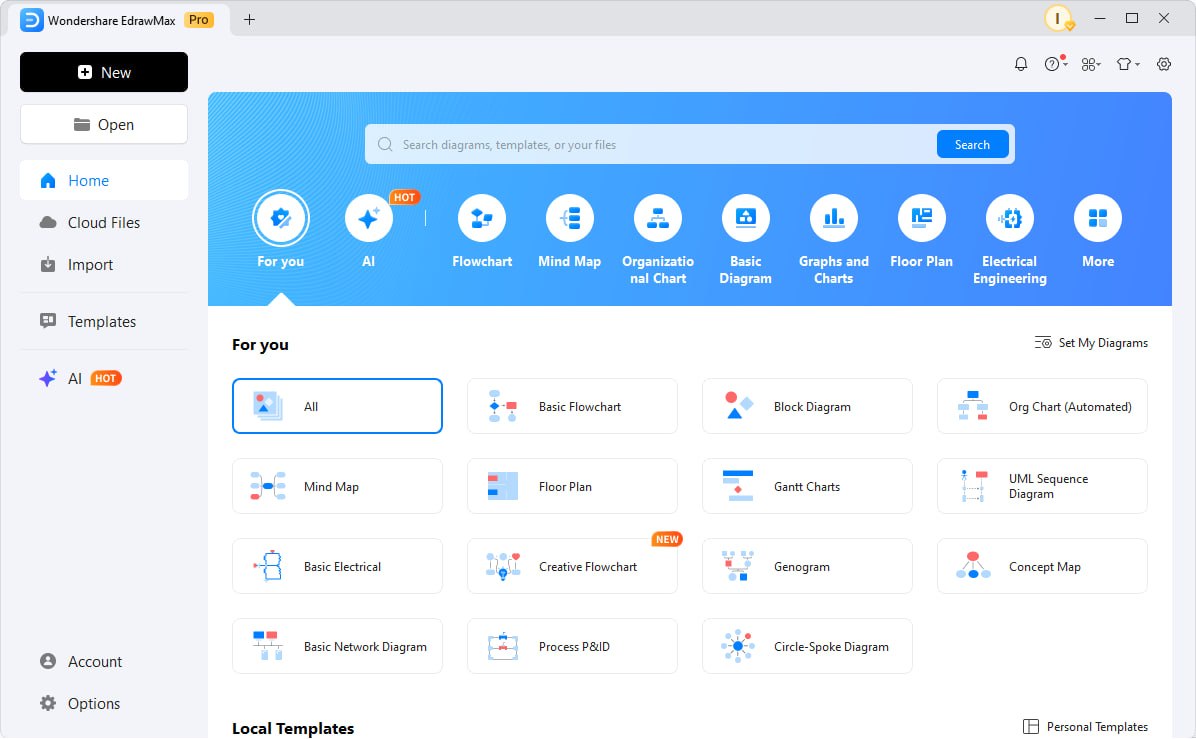
Table of Contents
ToggleSummary
EdrawMax 15.2.1.1532 is an AI-powered diagramming software developed by Wondershare. It allows you to create over 280 types of diagrams including flowcharts, mind maps, organizational charts, network diagrams, floor plans, and P&ID drawings. The first step to using this powerful tool is proper installation. Visit the official Wondershare EdrawMax website and download the version compatible with your operating system. The software supports Windows, macOS, and web browsers with seamless cloud sync across all platforms.
During installation, you will be asked to create a Wondershare account or sign in with Google, Facebook, or Apple credentials. An account is recommended because it enables cloud storage, cross-device synchronization, and access to the template community. After installation completes, launch the software.
You will see a welcome screen offering three options: start a new project, open an existing one, or browse templates. For first-time users, selecting “Browse Templates” is the best way to understand what EdrawMax can do. The software runs a quick hardware check on first launch, but no special configuration is needed for most systems.
Understanding The Dashboard
The EdrawMax dashboard is divided into five main areas that work together efficiently. On the left side, you will find the template gallery organized by categories like flowcharts, mind maps, org charts, network diagrams, floor plans, and engineering diagrams. Each category contains dozens of pre-built templates that you can use as starting points. The center area displays your recent projects and a large “Create New” button. The top menu bar contains File, Edit, View, Insert, Page Layout, and Tools options.
On the right side of the dashboard, you will see the symbol library panel. This is where it shines, it contains thousands of vector symbols for different diagramtypes. When you select a diagram category, the symbol library automatically switches to show relevant symbols.
The AI assistant icon sits in the top right corner, represented by a small sparkle symbol. Clicking this opens a text box where you can type prompts like “create a project management flowchart” or “design a three-level org chart.”
Creating First Project
To create your first project, click the “Create New” button on the dashboard or press Ctrl+N on your keyboard. You will be presented with a list of diagram categories. For this tutorial, select “Flowchart” because it is the most common diagram type. A blank canvas will open with a default page size of A4 in landscape orientation. The first thing you should do is set your page properties. Go to Page Layout in the top menu and adjust paper size, orientation, and margin settings according to your needs.
Now use the AI-powered diagram generation feature. Click the AI assistant icon and type a prompt such as “create a customer support ticket handling flowchart.” Within five to ten seconds, it will generate a complete flowchart with decision points, action boxes, and connectors. This feature, introduced in version 15.2.1.1532, automatically transforms text prompts into editable vector diagrams. You can also paste raw text or import data sheets, and the AI will convert them into structured diagrams.
Once the AI generates the initial diagram, you can manually edit any element by clicking on it. To add a new shape, drag any symbol from the right-side library onto the canvas. To connect two shapes, hover near the edge of one shape until a blue arrow appears, then click and drag to the second shape.
Common Workflow Steps
After creating your first project, you will repeat several common workflow steps. Adding shapes is straightforward open the symbol library on the right, search for the shape you need using the search bar, and drag it onto the canvas.
It supports over 280 diagram types, so the symbol library adapts to whatever you are building. To add text to any shape, double-click the shape and start typing. You can format text using the mini toolbar that appears above the selected shape, which offers font selection, size, bold, italic, alignment, and color options.
Connecting shapes is the second major workflow step. It offers smart connectors that automatically reroute themselves when you move shapes. To add a connector, click the Connector tool in the toolbar or press Ctrl+Shift+C. Then click the first shape, click the second shape, and a line appears. The software automatically finds the shortest path between shapes.
Exporting Files
Once your diagram is complete, exporting it in the correct format is essential. EdrawMax 15.2.1.1532 supports exporting to over fifteen different file formats. Click File in the top menu, then Export, and choose your desired format.
The most commonly used formats are PDF for document sharing, PNG for high-quality images, JPEG for smaller file sizes, SVG for web graphics, and Word or PowerPoint for direct insertion into office documents. For each format, you can adjust export settings such as resolution (72 to 300 DPI), image quality, and background transparency.
If you need to share your diagram with someone who does not have EdrawMax, exporting as PDF or PNG is the best option. For teams collaborating on the same diagram, save your file to EdrawCloud. Click File > Save to Cloud.
This uploads your diagram to Wondershare’s cloud storage, where you can generate a shareable link. You can set permissions to view only, comment only, or edit. Recipients do not need an EdrawMax license to view cloud-shared diagrams; they can open them in any web browser.
Troubleshooting
Even well-designed software can encounter issues. The most common problem in EdrawMax 15.2.1.1532 is the software running slowly when working with very large diagrams. If your diagram contains more than 500 shapes, try reducing the number of visible layers or splitting the diagram into multiple pages.
You can also go to View > Performance and enable “Simplified Rendering Mode,” which disables some visual effects but keeps editing smooth. Another common issue is missing symbols in the library. If you cannot find a specific symbol, use the search bar at the top of the symbol panel. Type the symbol name, and it searches across all installed libraries.
If the AI diagram generation feature does not produce the expected results, your prompt may be too vague. Instead of typing “create a flowchart,” type “create a software development lifecycle flowchart with requirements, design, development, testing, and deployment phases.” The AI works best with specific, detailed prompts. For export problems where the output file looks different from what you see on screen, check your page setup. Go to Page Layout and ensure the paper size and orientation match your export settings.
Productivity Tips
To become truly efficient in EdrawMax 15.2.1.1532, master these productivity techniques. Keyboard shortcuts save the most time. Press Ctrl+D to duplicate any selected shape. Press Ctrl+G to group multiple shapes together so they move as one unit. Press Ctrl+Shift+G to ungroup. Press F2 to edit text of the selected shape without double-clicking. Press Ctrl+Shift+C to copy formatting from one shape and Ctrl+Shift+V to paste it onto another. These shortcuts alone can cut your diagramming time in half.
Use templates as starting points rather than building from scratch. It includes thousands of pre-built templates for network topologies, floor plans, org charts, and P&ID diagrams. When you find a template you like, click “Use Immediately” and then customize every element. You can save your own custom templates by clicking File > Save As Template. Name your template and choose a category.
Your saved templates appear in the My Templates section of the dashboard. For recurring diagram types, this feature eliminates repetitive setup work. Finally, use the Auto Backup feature. Go to File > Options > Backup and set the auto-save interval to five minutes. This ensures you never lose work due to power failures or unexpected crashes.
Best Companion Tools
It works well alongside several other tools to create a complete documentation workflow. Microsoft Office is the most obvious companion. With the EdrawMax add-in installed, you can insert any diagram directly into a Word document, PowerPoint presentation, or Excel spreadsheet. The diagram remains editable, double-clicking it in Office launches EdrawMax for changes. This integration is especially valuable for business users who produce reports, proposals, and presentations regularly.
For teams working remotely, pair EdrawMax with project management tools like Trello, Asana, or Jira. Export your workflow diagrams as PNG or PDF and attach them to project tasks. For software development teams, export UML diagrams and ER diagrams directly as images and embed them in Confluence or Notion documentation pages. For cloud storage, it integrates with Google Drive, Dropbox, and OneDrive. You can save diagrams directly to these services from within the software.
For AI-assisted writing, tools like ChatGPT or Claude can help you write descriptive text for your diagrams, which you can then paste into EdrawMax shapes. Some users even ask ChatGPT to generate a text description of a process, then paste that description into EdrawMax’s AI prompt box to generate the diagram automatically.
Conclusion
This is the most comprehensive diagramming tool available today for professionals, educators, and students. The software’s AI-powered diagram generation, massive template library with over 280 diagram types, and seamless cross-platform compatibility make it superior to alternatives like Microsoft Visio, Lucidchart, and Draw.io. The ability to transform text prompts into editable vector diagrams in seconds is a game-changer for anyone who creates diagrams regularly.
Frequently Asked Questions
1. Is EdrawMax 15.2.1.1532 free or paid?
It offers both a free version and paid plans. The free version includes basic features but limits the number of exported files and includes a watermark. Paid plans remove all limitations and unlock the full AI diagram generation, cloud storage, and all 280+ diagram types. A free trial of the Pro version is available for 7 days.
2. Can EdrawMax import Visio files?
Yes. It fully supports importing Microsoft Visio files in VSDX and VSD formats. When you import a Visio file, all shapes, connectors, text, and formatting are preserved. You can then edit the diagram using EdrawMax tools and export back to Visio format if needed.
3. Does EdrawMax work offline?
Yes. The desktop version of EdrawMax works completely offline once installed. You do not need an internet connection to create, edit, or save diagrams. The AI diagram generation feature and cloud sync do require an internet connection, but all manual diagramming tools work offline.
4. What diagram types does EdrawMax support?
It supports over 280 diagram types including flowcharts, mind maps, organizational charts, network diagrams, floor plans, electrical and P&ID diagrams, UML diagrams, ER diagrams, Gantt charts, infographics, timelines, Venn diagrams, SWOT analysis, and more. A complete list is available in the template gallery.
5. Can multiple people edit the same diagram simultaneously?
Yes, with EdrawCloud. When you save a diagram to EdrawCloud, you can share a link with team members. Multiple people can open and edit the same diagram in real time. Changes appear instantly for all users. This feature requires an internet connection and a Pro subscription.
6. Is EdrawMax available for Mac and Linux?
It is available for Windows and macOS as a desktop application. For Linux users, a web-based version runs in any modern browser. The web version includes most features but may have limitations on very large diagrams. Cloud sync works across all platforms.
7. How accurate is the AI diagram generation?
The AI feature in EdrawMax 15.2.1.1532 is highly accurate for standard diagram types like flowcharts, org charts, and mind maps. For complex technical diagrams like P&ID or electrical schematics, the AI provides a solid starting point that typically requires minor manual adjustments. The accuracy improves significantly with detailed text prompts.
8. Can I use EdrawMax for professional engineering diagrams?
Yes. It includes specialized libraries for P&ID (Piping and Instrumentation Diagrams), electrical circuit diagrams, HVAC plans, and industrial floor plans. These libraries comply with industry standards including ANSI, ISO, and IEEE symbols. Many engineers use EdrawMax as a more affordable alternative to dedicated engineering diagram software.