CueTimer V4 – Smart Countdown Timer for Live Events – Latest 2026
Summary
CueTimer is a professional countdown timer software designed specifically for live events, broadcast studios, church services, sports events, and corporate presentations. Unlike generic timer apps that simply count down, CueTimer V4 is built for production environments where timing precision, visual clarity, and remote control are essential.
The software serves production directors, technical directors, stage managers, broadcasters, and church media teams. It displays countdown timers on screens visible to speakers, performers, and production staff while remaining invisible to the audience. This allows presenters to manage their time without looking at wristwatches or being distracted by on-screen clocks.
Real Informational Sections
1. Multi-Display Output
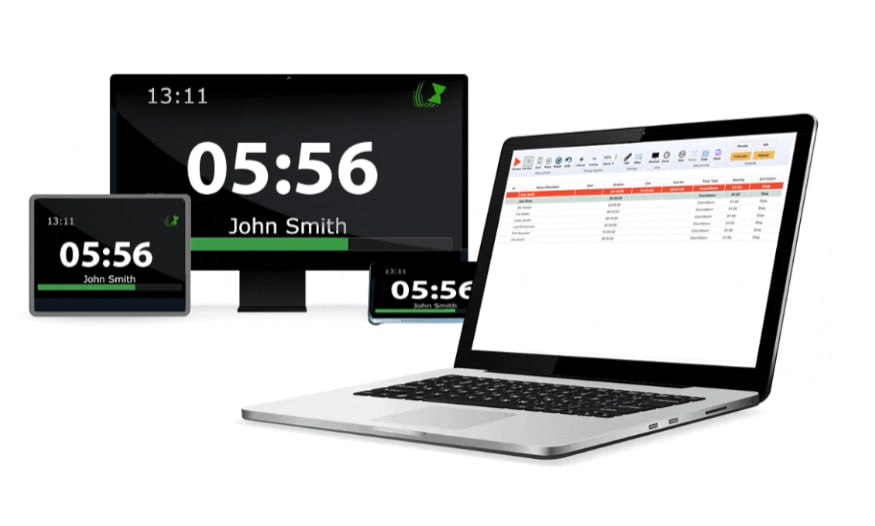
In a live production workflow, the director needs timers visible in specific locations: one on the stage floor for the speaker, one at the production console for the director, one in the green room for waiting presenters. It supports up to eight independent displays simultaneously.
Each display can show different countdowns, different styles, and different information. The stage display might show a large 5-minute countdown with yellow-to-red warning zones. The director’s display might show the same countdown plus remaining segments, transition cues, and overrun warnings. The green room display might show the schedule of upcoming presenters and their allocated times.
For a beginner, this means you install CueTimer on one computer, connect multiple monitors or projectors, and configure each display independently. No additional hardware or software is required.
2. Advanced Triggering and Automation
It can be triggered manually, by schedule, or by external events. In a church service, the timer might start automatically when the pastor steps to the podium (triggered by a floor sensor or audio level). In a broadcast studio, the timer might start when the director cues the segment.
The software supports GPIO triggers (physical buttons or foot pedals), MIDI commands from lighting consoles, network commands from production automation systems, and keyboard shortcuts. This integration allows the timer to become part of the overall production workflow rather than a separate device requiring dedicated attention.
3. Visual Customization
Every aspect of the timer display is customizable. You can choose fonts, colors, backgrounds, animations, and warning zones. For broadcast, you can output the timer as a keyed signal (transparent background) for overlay on video. For stage use, you can display the timer over a logo or branded background.
Warning zones are critical for live events. Set a 5-minute countdown to display in green, turn yellow at 1 minute, turn red at 30 seconds, and flash at 10 seconds. It supports multiple warning thresholds with customizable colors and animations.
4. Logging and Reporting
After the event, it generates a log showing actual times versus scheduled times. Did the keynote speaker take 42 minutes instead of the allocated 30? Did the panel discussion run 15 minutes over? The log provides data for post-event analysis and future planning.
Beginner Guidance
Step 1: First-Time Setup
Download and install CueTimer V4 on a Windows PC. The installer is small (under 50MB) and completes in under one minute. Launch the software. The main window shows a default countdown timer and a control panel.
Step 2: Interface Understanding
The CueTimer V4 interface has three main areas. The preview window shows what the audience or stage display will see. The control panel contains buttons for Start, Pause, Reset, and Set Time. The configuration panel contains tabs for Display Settings, Triggers, and Network.
For beginners, focus on the preview window and control panel first. Set a time using the up/down arrows or by typing minutes and seconds. Click Start. The timer counts down, changes color at warnings, and displays a notification at zero.
Step 3: Starting Workflow
-
Connect your computer to the display that will show the timer
-
Launch CueTimer V4
-
In Display Settings, select which monitor will show the timer
-
Set your countdown duration
-
Click Start
-
Use the control buttons during the event
Step 4: Common Beginner Mistakes
-
Forgetting to set the correct monitor output
-
Not testing the display before the event
-
Using a laptop that goes to sleep during long events (disable sleep mode)
-
Relying on internet synchronization without testing network reliability
Practical Usage
- Church Services: A church uses CueTimer V4 to time sermons, music sets, and offering segments. The timer is displayed on a small screen at the front of the stage, visible to the pastor but not the congregation. At the 40-minute mark, the display turns yellow. At 45 minutes, it turns red. The pastor sees the warning and concludes within the allotted time.
- Broadcast News: A news studio uses iy to time segments during live broadcasts. The director sees a precise countdown for each segment. When the timer reaches zero, the director cues the next segment. The talent sees a different display showing remaining time for their segment.
- Corporate Events: A corporate event planner uses CueTimer V4 to manage multiple presenters over a full-day conference. Each speaker has an allocated time. The timer is displayed on a confidence monitor at the podium. The speaker sees their remaining time without looking at a wristwatch.
- Sports Events: A sports venue uses this for halftime shows, timeout clocks, and pre-game warmup periods. The timer is displayed on the main scoreboard and on monitors in team locker rooms.
- Theater Productions: A stage manager uses CueTimer V4 to time scene changes, musical numbers, and intermissions. The timer is displayed on the stage manager’s console and on monitors backstage.
Performance Discussion
- It responds to start, stop, and reset commands instantly. There is no perceptible latency between clicking a button and the timer responding. This is critical for live events where timing changes happen in real time.
- It runs for hours or days without crashing. The software is designed for continuous operation during long events. It does not have memory leaks that degrade performance over time.
- It can manage multiple timers simultaneously. In a complex production, you might have a main show timer, a segment timer, and a break timer all running at once. Each timer can be displayed on different screens with different styles.
- It uses minimal CPU and RAM. A computer with 4GB RAM and any Intel or AMD processor is sufficient. The software does not require a dedicated graphics card. This allows production teams to use older laptops or secondary computers for timer display without investing in new hardware.
- When using network synchronization or remote control, it uses minimal bandwidth. The control protocol is lightweight and works reliably even on congested networks.
Alternatives to CueTimer V4
| Software | Key Features | Pricing | Best For |
|---|---|---|---|
| CueTimer V4 | Multi-display, network control, GPIO triggers | $$ (perpetual) | Professional live events |
| Stage Timer | Single display, basic controls | Free / $ | Small events, churches |
| Presentation Timer | PowerPoint integration, single display | $ | Corporate presentations |
| Countdown Timer (online) | Web-based, no installation | Free | Quick, simple timers |
| Phone timer apps | Basic countdown, no external display | Free / $ | Personal use |
| Hardware countdown timer | Dedicated device, expensive | $$$ | Broadcast studios |
Why Choose CueTimer V4 Over Alternatives?
CueTimer V4’s multi-display capability is unique. Most alternatives only output to one screen. For professional events where different stakeholders need different information, it is the only practical solution.
The GPIO trigger support (physical buttons) is essential for stage use. A stage manager can start and stop the timer with a foot pedal, keeping hands free for other tasks.
The network control allows the timer to be operated from a mobile device. The director can start the timer from their tablet while moving around the venue.
Frequently Asked Questions
Q1. What operating systems does CueTimer V4 support?
It runs on Windows 10 and Windows 11. There is no macOS version. The software runs on Windows laptops, desktops, and industrial PCs.
Q2. Can I control CueTimer V4 from my phone?
Yes. It includes a web-based remote control. Connect your phone to the same network as the computer running it, open a browser, and enter the computer’s IP address and port. The remote interface allows start, stop, pause, reset, and time setting.
Q3. How many displays can I connect?
It supports up to eight independent displays. Each display can show different timers, different styles, and different information.
Q4. Can I start the timer with a foot pedal?
Yes. It supports GPIO triggers. Connect a simple foot pedal or push button to the computer via USB. Assign the pedal to the Start command.
Q5. Does CueTimer V4 work with broadcast switchers?
Yes. It can output the timer as a keyed signal (transparent background) for overlay on video. It can also send time remaining data via serial or network to broadcast automation systems.
Q6. Is there a free trial?
Yes. It offers a 30-day free trial with full features. No credit card is required for the trial.
Q7. How accurate is the timer?
It uses the computer’s system clock and is accurate to milliseconds. For long events (hours), drift is negligible. For synchronization with broadcast timecode, it can receive SMPTE timecode.
Q8. Can I schedule timers in advance?
Yes. It includes a scheduler. Set timers for specific times of day. The timer starts automatically at the scheduled time.
Q9. What happens when the timer reaches zero?
You configure the behavior. Options include: stop and display zero, flash, play a sound, send a network command, start another timer, or continue counting negative (overtime).
Q10. Is technical support included?
Email support is included with purchase. Phone support is available with premium support plans. The software includes a help file and video tutorials.
Final Thoughts
CueTimer V4 is the professional choice for countdown timers in live events. The software is not flashy or feature-bloated. It does one thing and does it exceptionally well: displays precise, customizable countdown timers where you need them. The multi-display capability sets CueTimer V4 apart from consumer alternatives. A single laptop running CueTimer can drive timers for the stage, the director, backstage, and the broadcast control room simultaneously. Each display shows exactly what its viewer needs to see.