ENGISSOL 2D Frame Analysis 7.3.4 (Advanced Structural Analysis Software) Latest 2026
Summary
ENGISSOL 2D Frame Analysis 7.3.4 is a powerful finite element method (FEM) software designed for structural engineers to analyze 2D trusses, frames, and multi-span beams. It features an intuitive interface that auto-generates nodes and supports robust static, thermal, and dynamic calculations, including modal analysis and time-dependent loading. Structural engineers use this software to model, analyze, and evaluate 2D frame and beam structures with precision and efficiency.
The software provides advanced tools for load analysis, stress and deflection calculations, support reactions, and structural performance evaluation, enabling accurate assessment of engineering designs. With its intuitive interface, high-accuracy finite element analysis capabilities, and comprehensive reporting features, ENGISSOL 2D Frame Analysis 7.3.4 helps optimize structural designs while improving engineering productivity and decision-making.
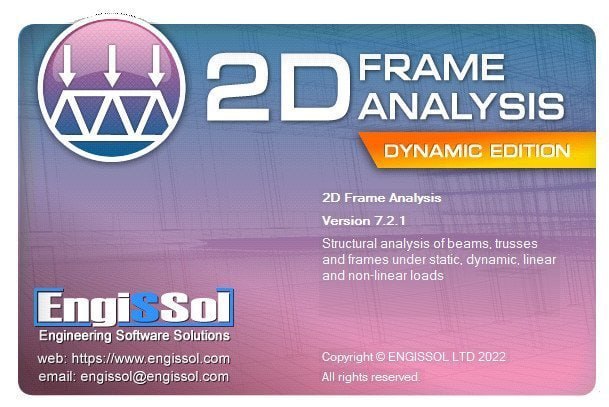
The dynamic edition of 2D Frame Analysis is a powerful application that uses optimized finite elements (beam elements) in order to perform static and dynamic analysis of beams, portal frames, and trusses.
Why Structural Engineers Need 2D Frame Analysis Software
Structural engineers face complex challenges daily. They must design safe, efficient structures that withstand various loads and environmental conditions. Manual calculations for frames, trusses, and beams are time-consuming and error-prone. Simple structures might take hours to analyze by hand. Complex structures with multiple members and load combinations can take days or weeks. ENGISSOL 2D Frame Analysis solves this problem by automating the entire analysis process.
Engineers define the structure geometry once. They apply loads and boundary conditions. The software performs all calculations instantly. Results are displayed clearly with visual representations of deflections, stresses, and reactions. This speed and accuracy allow engineers to explore multiple design alternatives quickly, leading to better, more optimized designs.
Core Editions And Capabilities
Engissol offers two distinct editions of the software, both built on a modern, fast analysis engine. The Static Edition focuses on the linear static analysis of 2D trusses and frames. It includes thermal load evaluations, spring supports, and an automatic node generation feature that simplifies the modeling process. Engineers can quickly define structural geometry without manually specifying every node coordinate. The Dynamic Edition includes all static capabilities plus advanced dynamic analysis functions.
Key features include modal analysis for determining natural frequencies and mode shapes, eigenvalue estimation for stability analysis, user-controlled damping parameters for accurate dynamic response, and a custom mass matrix algorithm for precise mass representation. Both editions share the same user-friendly interface and powerful calculation engine, making it easy to upgrade from static to dynamic analysis as project requirements evolve.
Technical Specifications And Analysis Capabilities
The software offers unlimited capacity for nodes and beams, making it suitable for projects of any size. Each node has 3 degrees of freedom (DOF), while each beam has 6 DOF, providing comprehensive analysis of structural behavior. Supported loadings include point loads for concentrated forces, distributed loads for uniform or varying loads along members, element and node time-dependent loads for dynamic analysis, and thermal loads for temperature effects.
The software automatically generates professional calculation reports and stress calculations, saving engineers valuable documentation time. The unlimited node and beam capacity means engineers can analyze complex structures without worrying about software limitations. Whether analyzing a simple beam or a complex industrial frame, the software handles the analysis efficiently.
Key Features And Workflow Benefits
The intuitive interface auto-generates nodes, significantly reducing modeling time and minimizing input errors. Engineers can quickly define structural geometry by simply clicking to create nodes and connecting them with beam elements. The software’s robust calculation engine delivers accurate results for both simple and complex structures using optimized finite element formulations. The automated reporting feature generates professional calculation reports with stress calculations, support reactions, and deflection results.
This streamlines the documentation process and ensures consistent, error-free reports for project stakeholders. The software also includes visual display of deformed shapes, bending moment diagrams, shear force diagrams, and axial force diagrams, making interpretation of results intuitive and straightforward.
Load Types And Analysis Scenarios
ENGISSOL 2D Frame Analysis supports a wide range of load types. Point loads can be applied at any node or along a beam. Distributed loads can be uniform or variable along the beam length. Temperature loads simulate thermal expansion effects on structures. Time-dependent loads are essential for dynamic analysis. Load combinations allow engineers to evaluate multiple load cases simultaneously.
The software handles dead loads, live loads, wind loads, seismic loads, and thermal loads. Engineers can define load combinations according to design codes. The results include maximum displacements, support reactions, internal forces, and stresses. This comprehensive analysis ensures structures are safe and code-compliant.
Dynamic Analysis Capabilities In The Dynamic Edition
The Dynamic Edition of ENGISSOL 2D Frame Analysis provides advanced dynamic analysis features essential for structures subjected to vibrations, earthquakes, and moving loads. Modal analysis determines natural frequencies and mode shapes, helping engineers identify potential resonance issues. Eigenvalue estimation assesses the stability of structures under compressive loads.
User-controlled damping parameters allow accurate modeling of energy dissipation in structures. The custom mass matrix algorithm provides precise mass representation for dynamic response calculations. These capabilities are essential for designing structures that can withstand dynamic loads from wind, earthquakes, machinery vibrations, and impact events.
Reporting And Documentation
Professional reporting is a key feature of ENGISSOL 2D Frame Analysis. The software automatically generates comprehensive calculation reports that include all analysis inputs and results. Reports contain structural geometry, material properties, applied loads, support conditions, analysis results, and code checks. The report format is professional and suitable for submission to clients, authorities, and project stakeholders. Engineers can customize report content and format. Reports save hours of manual documentation time and ensure consistency and accuracy. All results are presented clearly with tables, diagrams, and charts.
System Requirements And Installation
Version 7.3.x is the primary release line for both the Static and Dynamic Editions. The software is designed for Windows operating systems and requires a standard PC configuration suitable for engineering analysis applications. The installation process is straightforward and quick. Users can download demos and view tutorials on The Structural Engineer website or access detailed specifications through the official Engissol 2D Frame Analysis database. The software includes comprehensive help documentation and examples.
Frequently Asked Questions
Q1: What is ENGISSOL 2D Frame Analysis 7.3.4 used for?
It is a finite element method software for analyzing 2D trusses, frames, and multi-span beams with static, thermal, and dynamic analysis capabilities.
Q2: What is the difference between Static and Dynamic Editions?
The Static Edition handles linear static analysis including thermal loads. The Dynamic Edition adds modal analysis, eigenvalue estimation, damping, and time-dependent loading capabilities.
Q3: What types of loads does the software support?
It supports point loads, distributed loads, element and node time-dependent loads, and thermal loads.
Q4: Does the software have limits on nodes or beams?
No. The software offers unlimited capacity for nodes and beams, making it suitable for any project size.
Q5: What are the degrees of freedom in the software?
Each node has 3 DOF and each beam has 6 DOF, providing comprehensive structural analysis.
Q6: Can the software generate reports automatically?
Yes. It automatically generates professional calculation reports with stress calculations and analysis results.
Q7: What is modal analysis?
Modal analysis determines natural frequencies and mode shapes of a structure to identify potential resonance issues.
Q8: Is there a demo version available?
Yes. Demos and tutorials are available on The Structural Engineer website.
Technical Specifications
| Specification | Details |
|---|---|
| Software Name | ENGISSOL 2D Frame Analysis 7.3.4 |
| Category | Structural Analysis (FEM) Software |
| Developer | Engissol |
| Editions | Static Edition, Dynamic Edition |
| Primary Use | Analysis of 2D trusses, frames, and multi-span beams |
| Capacity | Unlimited nodes and beams |
| DOF | 3 per node, 6 per beam |
| Supported Loads | Point, distributed, time-dependent, thermal |
| Reporting | Automated professional calculation reports |
| Operating System | Windows |
| License Type | Commercial |