Dassault Systemes GEOVIA MineSched 2026 R1 Version 9.11.26673.1 (Smart Tactical Mine Planning) Download
Summary
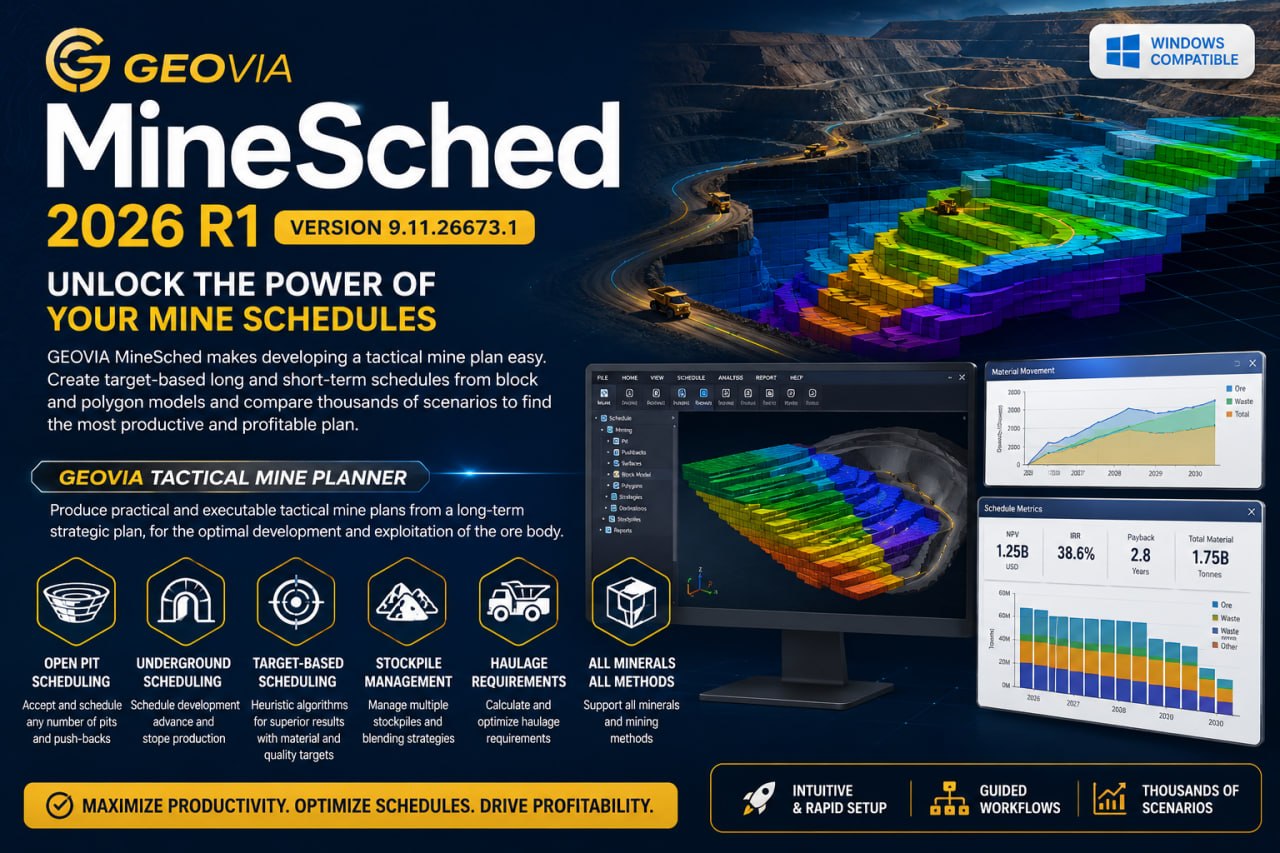
Dassault Systemes GEOVIA MineSched 2026 R1 (Version 9.11.26673.1) is an advanced tactical mine planning and scheduling software designed for both open-pit and underground operations. The software bridges the critical gap between strategic long-term mine plans and day-to-day operational execution, transforming validated strategic objectives into practical, actionable schedules that respect real-world operational constraints.
Operating at the tactical planning layer across months, weeks, and days, MineSched is employed by surface and underground mining operations of all types and sizes to produce schedules that meet capacity and material quality targets. The software is used by mining engineers, planners, and operations teams who need to create reliable production schedules that account for equipment constraints, bench management, haulage routes, and grade blending requirements.
The Role Of Tactical Scheduling In Modern Mining Operations
In mine planning, the transition from strategic objectives to operational execution represents one of the most demanding challenges for planning teams. Long-term optimization tools define optimal pit shells and model life-of-mine scenarios over multi-year horizons, but they are not built to address operational realities like equipment constraints, active bench management, haulage route efficiency, or grade blending requirements.
GEOVIA MineSched operates at the next layer, translating strategic outputs into schedules that reflect operational realities. The integration between these two layers is critical a strategic plan that cannot be executed reliably at the tactical level introduces significant reconciliation risk. MineSched addresses this by using the block model as its single source of truth, ensuring consistency across all planning stages.
Core Planning Capabilities And Operational Safety Controls
MineSched enables tactical pit sequencing that generates extraction sequences while respecting critical operational safety parameters. Planners can control key constraints such as the maximum number of active benches per period, ensuring safe levels of simultaneous bench exposure. Minimum mining widths are enforced to guarantee equipment access and face stability, and mining direction flexibility supports rapid scenario comparison when conditions change. Sequencing can be reviewed through configurable animations and dynamic dashboards, providing both visual and analytical confirmation that the sequence is safe and operational before field execution.
Integration With The Broader GEOVIA Ecosystem
MineSched 2026 R1 integrates seamlessly with the broader GEOVIA ecosystem, ensuring continuity between long-term planning and operational scheduling. The software offers direct read and write capabilities with Surpac block models and mine designs, enabling planners to work with the most current geological and mine design data without time-consuming data translation or re-entry.
This integration reduces errors and ensures consistency across all planning stages, from resource modeling to final production scheduling. The unified data environment also facilitates better collaboration between geology, mine planning, and operations teams, as everyone works from the same validated data sources.
Target-Based Sequencing And Grade Control
Short-term planning requires balancing plant feed consistency, stripping ratio, and ore blending. MineSched addresses this through its Quality Targets and Ratios module, enabling planners to define operational targets directly within the schedule. These include blend targets to maintain consistent head grade and maximize plant recovery, constant stripping ratio targets for operational continuity, and material proportion targets to control the throughput of high-grade ore. Because these targets are directly linked to the scheduling engine, the impact of sequencing decisions on plant feed can be evaluated immediately, reducing the risk of grade shortfalls and limiting unexpected processing variability.
Integrated Haulage Planning And Fleet Modeling
Short-term schedule reliability depends heavily on accurate haulage assumptions. MineSched integrates haulage planning directly into the scheduling environment, offering automatic route definition to generate optimal haul paths based on mine geometry and destination configurations.
Explicit road and access modeling allows haul roads and bench access roads to be defined so the plan reflects actual site infrastructure. Fleet aging simulation adjusts equipment utilization over time to reflect realistic productivity changes, while seasonal weather integration accounts for adverse conditions that impact haulage performance.
Production Priorities And Activity Sequencing
Operational schedules must extend beyond material extraction. The Production Priorities workflow in MineSched extends sequencing control to all mining activities, including drilling, blasting, loading, and hauling . Precedence rules are automatically generated based on bench elevation, reducing manual configuration effort. Additional priority rules can be defined to minimize bottlenecks between activities. This workflow ensures continuity between short-term and long-term planning horizons, using spatial precedence parameters that maintain consistency as the planning window evolves.
Stockpile And Tailings Dam Management
The 2026 release has focused specifically on quantifying the amount of process tailings and solid process waste, ensuring tailing dam capacities are not exceeded over the life of the mine. New Process Waste and Recovered Product reports ensure tactical mine plans are safe and practical to implement.
The software includes integrated tailings modeling covering tonnages, dynamic capacities, and pulp generation, with fixed or variable recovery factors by material, grade, and commodity. Stockpile capacity rules define maximum constraints with overflow management for practical routing under varying production conditions. This enhanced focus on tailings and waste management helps mining teams maintain compliance and operational safety.
Reporting And Data Integration
MineSched 2026 offers enhanced reporting tools for material recovered from the processing plant. Integrated reporting enables dashboards and extended reports to be generated directly in the tool, removing the need for external data processing before validation and communication.
The software supports flexible grade and metal unit configuration, aligning outputs with plant and corporate reporting requirements. Integration with the broader GEOVIA ecosystem ensures continuity between long-term planning and operational scheduling, with direct read and write capabilities with Surpac block models and mine designs.
Advanced Visualization And Scenario Analysis
GEOVIA MineSched 2026 R1 includes powerful visualization tools that enable planners to review sequencing through configurable animations and dynamic dashboards. These visual tools provide both visual and analytical confirmation that the sequence is safe and operational before field execution.
Planners can quickly compare different scheduling scenarios, evaluating the impact of changes in equipment availability, grade targets, or operational constraints. The ability to rapidly assess multiple scenarios helps mining operations respond to changing conditions, such as equipment breakdowns, grade variability, or market price fluctuations, ensuring that schedules remain realistic and achievable even in dynamic operating environments.
Licensing And Availability
GEOVIA MineSched 2026 R1 is available for download on the 3DS Support site. GEOVIA users covered under the Dassault Systèmes Support and Maintenance agreement can access it at no additional cost. The software requires Microsoft Windows 10 or 11 (64-bit), with minimum 8 GB RAM and a quad-core 64-bit processor recommended.
Frequently Asked Questions
Q1: What is GEOVIA MineSched 2026 R1 used for?
It is an advanced tactical mine planning and scheduling software for open-pit and underground operations, translating strategic plans into operational schedules.
Q2: What’s new in the 2026 R1 release?
The release focuses on quantifying process tailings and solid waste, enhanced plant recovery reporting, improved tailings dam tracking, and better integration with the GEOVIA ecosystem.
Q3: Does MineSched perform optimization or scheduling?
GEOVIA MineSched focuses on scheduling, applying heuristic algorithms to achieve user-defined targets within configured constraints. It does not perform optimization.
Q4: What are the key planning capabilities of MineSched?
Capabilities include pit sequencing with safety controls, target-based grade control, integrated haulage planning, production priorities, and stockpile management.
Q5: What are the system requirements for MineSched 2026?
The software requires Windows 10 or 11 (64-bit), minimum 8 GB RAM, and a quad-core 64-bit processor. 16 GB RAM is recommended.
Q6: How do I access MineSched 2026 R1?
The software is available for download on the 3DS Support site for active maintenance subscribers.
Technical Specifications
| Specification | Details |
|---|---|
| Software Name | Dassault Systemes GEOVIA MineSched 2026 R1 |
| Version | 9.11.26673.1 |
| Category | Tactical Mine Planning and Scheduling Software |
| Developer | Dassault Systèmes (GEOVIA) |
| Primary Use | Short and medium-term mine scheduling for open-pit and underground operations |
| Key Features | Pit sequencing, grade control, haulage planning, tailings management |
| Operating System | Windows 10, Windows 11 (64-bit) |
| Minimum RAM | 8 GB (16 GB+ recommended) |
| License Type | Commercial |