CareUEyes Pro v2.6.2.0 – Eye Protection & Blue Light Filter Software
by admin · August 24, 2026
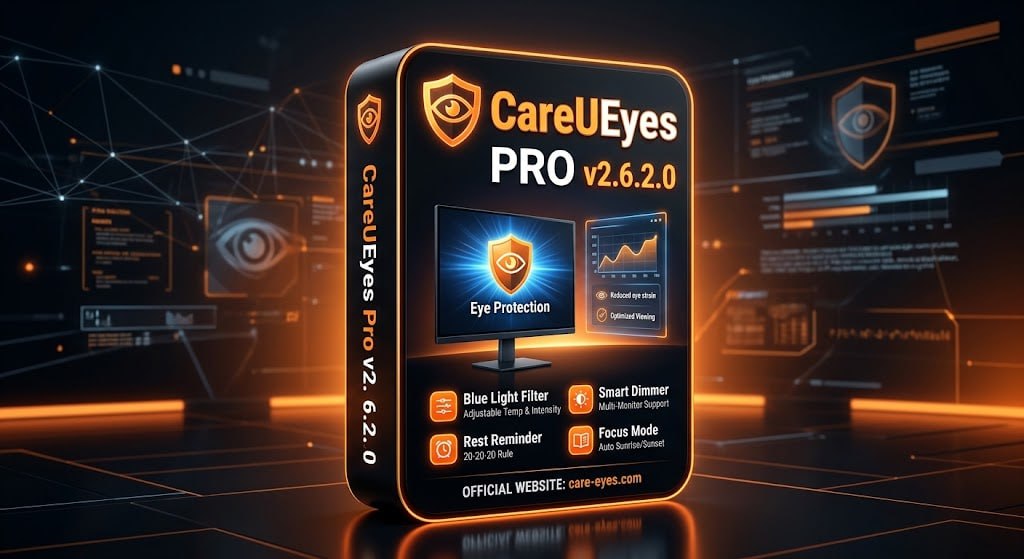
Table of Contents
ToggleSummary
CareUEyes Pro v2.6.2.0 is a blue light filter and screen dimmer application for Windows designed to reduce eye strain. It combines a blue light filter, screen dimmer, break reminder timer, and reading focus mode into one lightweight utility. If you are new to eye care software, you will quickly discover that Windows built-in Night Light is too basic; it only adds a yellow tint without adjusting brightness or reminding you to take breaks. CareUEyes solves these limitations by combining three essential features: blue light filtering, screen dimming, and break reminders, all in one simple interface.
CareUEyes is famous in the eye care market for its accuracy. Unlike overlay-based dimmers that make screens look muddy or gray, it uses GPU-level gamma adjustment. Text stays sharp, colors remain vibrant, and screenshots are not affected. You can set your screen to a warm 3000K night mode, but your screenshots will still capture original, bright colors.
Key Features
- Blue Light Filter: Automatically or manually adjusts screen color temperature (warmth) to block high-energy short-wavelength blue light.
- Screen Dimmer: Offers precise brightness control (1% accuracy) and deep dimming below normal monitor limits without adding flicker or PWM.
- Smart Presets: Includes 8 pre-configured modes like Normal, Smart, Office, Night, Game, Movie, Editing, and Reading.
- Break Timer: Promotes healthy viewing habits (like the 20-20-20 rule) with customizable work/rest intervals and optional screen locks.
- Focus Tools: Features Focus Read and Focus Blur to highlight active reading regions and darken background windows.
First Impression
When you first install CareUEyes Pro, the experience is straightforward. The installer is small (under 20MB) and completes in under 30 seconds. You are not asked to restart your computer.
After launch, a small control panel appears. The default settings are already active: the blue light filter is on, and brightness is set to auto-adjust based on time of day. You immediately notice the screen becomes warmer, with less harsh blue light hitting your eyes.
The main dashboard has four tabs: Display (color temperature and brightness controls), Timer (break reminder settings), Focus (highlight active window options), and Settings (hotkeys, startup, and language). For beginners, the Display tab is where you will spend most of your time.
What makes a strong first impression is the preset modes. Click “Read,” and the screen becomes warm and dim for comfortable reading. Click “Game,” and the screen becomes cooler and brighter for better visibility in dark game scenes. Click “Movie” and the colors are enhanced. Each mode feels different and appropriate for its task.
Main Editing Workspace
The CareUEyes interface is intentionally minimalist. The main control panel stays on top of other windows by default, but you can minimize it to the system tray.
- Display Tab: It contains a color temperature slider (0K to 10,000K) and a brightness slider (1% to 100%). Below the sliders are eight preset buttons: Normal, Custom, Game, Movie, Office, Night, Edit, and Read. Clicking any preset immediately applies the saved settings. The Custom preset allows you to save your own combination of color temperature and brightness.
- Timer Tab: It controls the break reminder. You set how often to be reminded (default 45 minutes) and how long the break should last. You can also enable “Lock screen during break” to enforce rest—the screen locks and you cannot work until the break ends. The 20-20-20 rule preset reminds you every 20 minutes to look at something 20 feet away for 20 seconds.
- Focus Tab: It helps reduce distractions. Focus Read highlights the active window and dims everything else. Focus Blur blurs background windows. Magic Window darkens or grays out any window you choose. These features are valuable for writers, programmers, and anyone who works with multiple windows open.
- Settings Tab: It allows configuration of hotkeys (Ctrl+Shift+B for blue light toggle, Ctrl+Shift+F for focus mode), startup behavior, and language selection.
Important Settings
Color Temperature: It is the most important setting. Lower temperatures (3000K-4000K) are warmer and reduce blue light significantly; use these at night. Higher temperatures (6500K-7500K) are cooler and more natural for daytime work. The default is 6500K (neutral white).
Auto Brightness: It automatically adjusts screen brightness based on your local sunrise and sunset. Enable this to reduce eye strain in dark rooms without manual adjustments. The software reads your location from system settings, or you can enter coordinates manually.
Break Reminder Interval: This should be set to 20 minutes if you follow the 20-20-20 rule. Set to 45 minutes if you prefer longer work sessions with fewer interruptions. The reminder appears as a desktop notification; you can dismiss or postpone it.
Multi-Monitor Sync: It is essential for users with two or more screens. You can adjust each monitor independently or sync all monitors to the same color temperature and brightness. This is a feature that Windows Night Light does not support.
Screenshot Protection: It is enabled by default. Your screenshots are never tinted or dimmed; they capture original colors regardless of your CareUEyes settings. This is critical for designers and anyone who needs to share screen captures.
Daily Usage Experience
In daily practice, it runs silently in the system tray. You forget it is there until you notice your eyes are not tired at the end of the day.
Morning (Office mode): Color temperature 6500K (neutral), brightness 80%. The screen looks natural. You work on spreadsheets and emails.
Afternoon (Reading mode): You switch to Read mode (5000K, 50% brightness) when reviewing long documents. The warmer light is easier on the eyes.
Evening (Night mode): After sunset, auto-brightness dims the screen gradually. By 10 PM, color temperature is 3500K (very warm). You can work late without disrupting your sleep cycle.
Gaming (Game mode): You play a dark horror game. Game mode (8000K, 100% brightness) makes shadows more visible. The screen is bright, but blue light is still filtered appropriately.
Coding (Focus mode): You enable Focus Read while programming. The code editor window is bright; all other windows are dimmed. You concentrate better without visual clutter.
Performance During Projects
It is extremely lightweight. CPU usage is under 0.5% on modern processors. Memory usage is approximately 30-50MB. You will not notice any performance impact, even during gaming or video editing.
The auto-brightness feature transitions smoothly. When the sun sets, the brightness decreases gradually over 30 minutes. You never notice a sudden change.
Break reminders appear reliably. The notification pop-up does not steal focus from your active application. You can dismiss it with one click and continue working.
Multi-monitor performance is excellent. Independent brightness controls work correctly even on mismatched monitors (one 4K, one 1080p). There is no lag when adjusting settings.
The only performance consideration is that very low brightness settings (below 5%) may make some OLED screens appear uneven. This is a hardware limitation, not a software issue.
Helpful Tips
- Use the 20-20-20 rule preset instead of the default 45-minute reminder. Your eyes will thank you after a year of daily use.
- Set up hotkeys for your most-used modes. I use Ctrl+Shift+1 for Office mode, Ctrl+Shift+2 for Night mode, and Ctrl+Shift+3 for Focus mode. Switching modes takes one second.
- Enable auto-start so it launches when Windows starts. You will never forget to enable eye protection.
- If screenshots are yellow, check that “No yellow screenshots” is enabled in Settings. This feature is unique to CareUEyes and is disabled by default in some versions.
- Use Magic Window for video calls. Darken or grayscale the video call window to reduce distractions while keeping the meeting content visible.
- Do not set the color temperature below 3000K during the day. The screen will be too yellow for accurate color perception. Save extreme warmth for late night only.
Better Alternatives
| Software | Key Features | Pricing | Best For |
|---|---|---|---|
| CareUEyes Pro | GPU-level dimming, multi-monitor, focus mode, break timer | $ (subscription) | Professional eye protection |
| f.lux | Auto color temperature, free | Free | Budget users, basic needs |
| Windows Night Light | Basic blue light filter | Free (built-in) | Minimal protection |
| Iris | Blue light filter, break timer | $ (one-time) | Advanced users, multiple devices |
| LightBulb | Open-source, gamma adjustment | Free | Technical users |
| Redshift | Linux-based | Free | Linux users |
Why Choose CareUEyes Pro Over Free Alternatives?
Free tools like f.lux and Windows Night Light only adjust color temperature. They do not control brightness independently, do not include break reminders, and do not support multi-monitor independent adjustment. CareUEyes is a complete solution.
Why Choose CareUEyes Pro Over Iris?
Iris offers similar features but has a more complex interface. It is simpler to use. It also handles screenshots correctly (no yellow tint), which Iris does not.
Closing Opinion
CareUEyes Pro 2.5.1 is an essential utility for anyone who spends 6+ hours daily in front of a computer. The software does one thing well: it reduces eye strain without getting in your way.
For beginners, the learning curve is nonexistent. Install, accept the defaults, and your eyes will feel the difference within a week. The 20-20-20 break reminder alone is worth the price most users forget to take breaks until their eyes hurt. CareUEyes reminds you before the pain starts.
What sets CareUEyes apart from free alternatives is the combination of blue light filtering, precise brightness control, and break reminders all in one lightweight package. The GPU-level gamma adjustment means no flicker, no washed-out colors, and screenshots that remain accurate.