Light Steel Framing (LSF) Design with SAP2000 & CSI SAFE
Summary
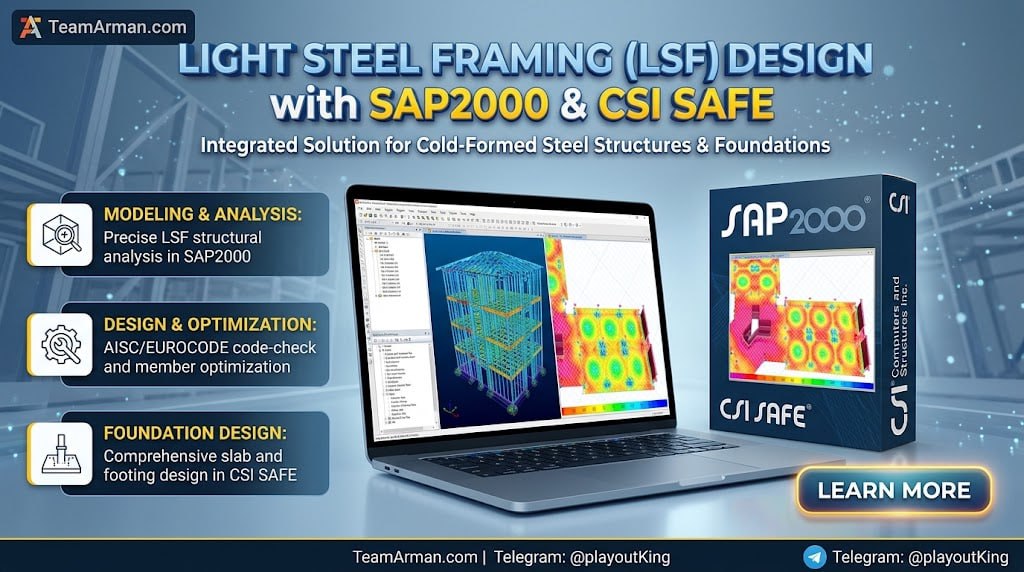
Light Steel Framing (LSF) design combines SAP2000 for analyzing 3D superstructures and CSI SAFE for designing concrete foundations and floor slabs. This integrated software workflow is used by structural engineers, civil designers, and BIM professionals who work with cold-formed steel (CFS) building systems. LSF construction has become widely adopted for multi-story residential buildings, commercial developments, industrial warehouses, and modular construction projects due to its lightweight nature, speed of erection, and cost efficiency.
The combination of SAP2000 and CSI SAFE provides a complete solution that covers the structural analysis of the steel superstructure and the design of the concrete foundation system, ensuring that the entire load path from roof to ground is properly analyzed and documented.
Modeling And Analysis In SAP2000
The LSF design process begins by creating a comprehensive 3D model of the building in SAP2000, including all wall studs, floor joists, roof trusses, bracing, and connections. Engineers define cold-formed and hot-rolled steel materials and structural sections, assigning appropriate yield strength and thickness properties for the thin-walled CFS members. Gravity loads (dead and live), lateral loads (wind and seismic), partition loads, and snow loads are applied based on local design codes such as ASCE 7.
SAP2000 performs the global analysis to determine the overall response of the structure, providing internal forces and moments in each member, checking member stresses, buckling behavior, and lateral displacements. The software’s cold-formed steel frame design capabilities support AISI standards for CFS member design, ensuring code compliance throughout the analysis phase.
Load Transfer From Superstructure To Foundation
Once the global analysis is complete in SAP2000, the support reactions and column loads from the superstructure model are exported and transferred into CSI SAFE. This load transfer is a critical step in the workflow, as it ensures that the foundation design is based on the actual forces generated by the LSF structure above. Engineers can export reactions from SAP2000 and import them into CSI SAFE using Excel or file-based exchange methods.
The imported loads include axial forces and moments from the base of the LSF structure, which then serve as the basis for designing the foundation system. This seamless integration between the two software platforms eliminates manual data entry, reduces the risk of errors, and significantly improves workflow efficiency.
Foundation Design In CSI SAFE
In CSI SAFE, engineers model the foundation layout, including basemats, strip footings, isolated footings, raft foundations, or slab-on-grade, using the subgrade modulus for soil support. The software provides multiple options for modeling foundation systems, including the mat option or thick-plate slab-on-grade for raft foundations. SAFE performs comprehensive design checks, including soil bearing pressure verification, punching shear analysis, uplift checks, and reinforcement detailing.
For Light Steel Framing buildings with concrete floor systems, SAFE’s punching shear analysis at column connections is critical for preventing brittle failures and ensuring a safe structural design. The software designs footings and concrete floor slabs, performing all necessary code checks according to ACI design provisions.
Cold-Formed Steel Section Design And Optimization
The Light Steel Framing workflow in SAP2000 includes specialized tools for cold-formed steel section design, allowing engineers to define thin-walled sections with specific yield strengths, thicknesses, and geometric properties. The software performs automated code checks against AISI standards, verifying member capacity for axial, flexural, and combined loading conditions.
Design optimization features allow engineers to adjust section sizes and thicknesses to achieve the most efficient structural solution while maintaining code compliance. This level of automation significantly reduces the iterative design time that would otherwise be required when manually checking each member against code requirements.
Soil-Structure Interaction And Subgrade Modeling
CSI SAFE allows engineers to model soil support using the subgrade modulus, which represents the relationship between soil pressure and deflection beneath the foundation. Different subgrade modulus values can be assigned to different regions of the foundation to account for variations in soil conditions, which is particularly important for LSF buildings constructed on sites with heterogeneous soil profiles.
The software calculates soil bearing pressures across the entire foundation footprint, verifying that the allowable bearing capacity of the soil is not exceeded. Uplift checks ensure that the foundation remains stable under wind loading, which is a critical consideration for lightweight LSF structures that are more susceptible to uplift forces than heavier traditional construction.
Practical Workflow And Project-Based Learning
The integrated Light Steel Framing design workflow is best learned through a complete real-world project that covers modeling and loading, structural analysis, member design, and foundation design using SAP2000 and CSI SAFE. Engineers begin by developing the structural model of an LSF building, defining materials, sections, and structural properties, then applying appropriate load cases and combinations. After running the analysis, the results are interpreted to design and verify LSF structural members, checking critical elements of the system.
The workflow then continues with foundation modeling and design in CSI SAFE, allowing engineers to follow the structural workflow from superstructure to foundation. This project-based approach ensures that every major concept is applied directly to a complete LSF building rather than being taught through disconnected examples.
Frequently Asked Questions
Q1: What is Light Steel Framing (LSF) design with SAP2000 and CSI SAFE used for?
It is an integrated structural engineering workflow that combines SAP2000 for analyzing 3D LSF superstructures and CSI SAFE for designing concrete foundations and floor slabs.
Q2: What types of structures benefit from this workflow?
Multi-story residential buildings, commercial and mixed-use developments, industrial warehouses, and modular construction projects that use cold-formed steel framing.
Q3: How are loads transferred from SAP2000 to CSI SAFE?
Support reactions and column loads from the SAP2000 superstructure model are exported and imported into CSI SAFE using Excel or file-based exchange methods.
Q4: What foundation types can be designed in CSI SAFE for LSF buildings?
CSI SAFE supports basemats, strip footings, isolated footings, combined footings, raft foundations, and slab-on-grade systems.
Q5: Does SAP2000 support cold-formed steel design?
Yes, SAP2000 includes cold-formed steel frame design capabilities with support for AISI standards.
Q6: What design codes are supported in this workflow?
Both SAP2000 and CSI SAFE support current building codes including AISC, AISI, ACI, and ASCE 7 for loads and design provisions.